简体中文
简体中文 Deutsch
 日本語
日本語 한국어
한국어 Tiếng Việt
 Русский
 ไทย
ไทย Bahasa Indonesia
 Bahasa Melayu
 Filipino
 لالعربية
 Français

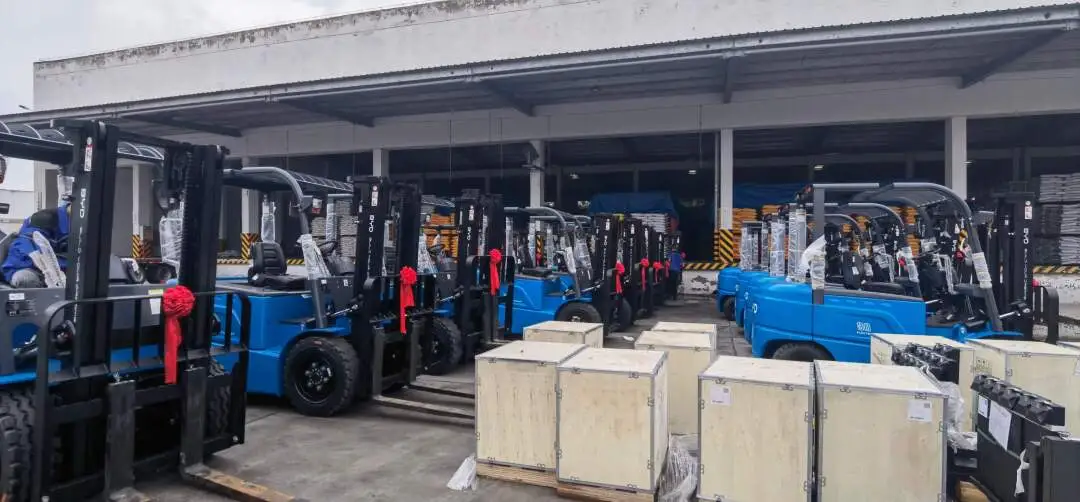
Food workshop as a direct contact with food raw materials, work in progress and finished products of the production scene, the internal work equipment hygiene, performance, safety are much higher than the requirements of ordinary industrial scenes, electric forklift as the workshop material transfer core equipment, selection and use need to meet a number of special specifications.
Hygiene compliance is the primary requirement for electric forklifts in food workshops.
The first is that the material of the contact parts should be up to standard. All parts that may come into contact with food should be made of materials that are resistant to corrosion, odor-free, and not easy to fall off debris. They meet the relevant general standards for food contact materials to avoid contamination of food.
Secondly, the structural design should be easy to clean. The overall design of the forklift should minimize gaps, grooves and other sanitary dead ends. The shell is smooth and non-raised, and the removable parts are easy to disassemble and assemble. It can quickly complete daily cleaning and disinfection to avoid the growth of bacteria from food residues. At the same time, the power system should be sealed to avoid electrolyte, lubricating oil and other substances leaking and polluting the production environment.
The operation performance should be adapted to the actual scene of the food workshop.
The first is the flexibility of the body to meet the standard. Most food workshops have narrow internal passages, and there are production equipment, shelves and other facilities around them. Forklifts need to have a small turning radius, high operation flexibility, and can complete steering, stacking and other operations in a narrow space without scratching the surrounding facilities.
Secondly, the load and operating stability should match the needs of the scene. Enterprises should choose forklifts with corresponding parameters according to the daily transfer of raw materials, the weight of finished products, and the stacking height. At the same time, the vehicle should be smooth and the braking should be sensitive to avoid material spills during transportation. In addition, operating noise should be controlled to avoid interfering with the normal production order of the workshop.
The safety protection configuration should conform to the workshop operation characteristics.
First of all, there must be a protective design suitable for the workshop environment. The circuit system should be waterproof and insulated to withstand daily cleaning and rinsing. In the case of water stains and oil stains on the ground, it must also have sufficient anti-skid ability to avoid slipping and rollover.
Secondly, it should be equipped with a perfect warning device. During operation, it can alert the surrounding personnel to avoid the risk of collision between people and vehicles through sound and light signals, and at the same time, it is equipped with anti-overload and over-temperature protection devices to avoid the failure of the equipment during long-term high-load operation.
When selecting an electric forklift for use in a food workshop, an enterprise must combine the actual needs of its own production scenarios and check the requirements one by one in order to improve the efficiency of material transfer, meet the hygiene and safety standards of food production, and avoid operational risks.