2026-06-17

Différences entre les chariots élévateurs à trois et à quatre points : analyse du BYD CPD18S à titre d'exemple

Différences entre les chariots élévateurs à trois et à quatre points : analyse du BYD CPD18S à titre dexemple(Figure1)

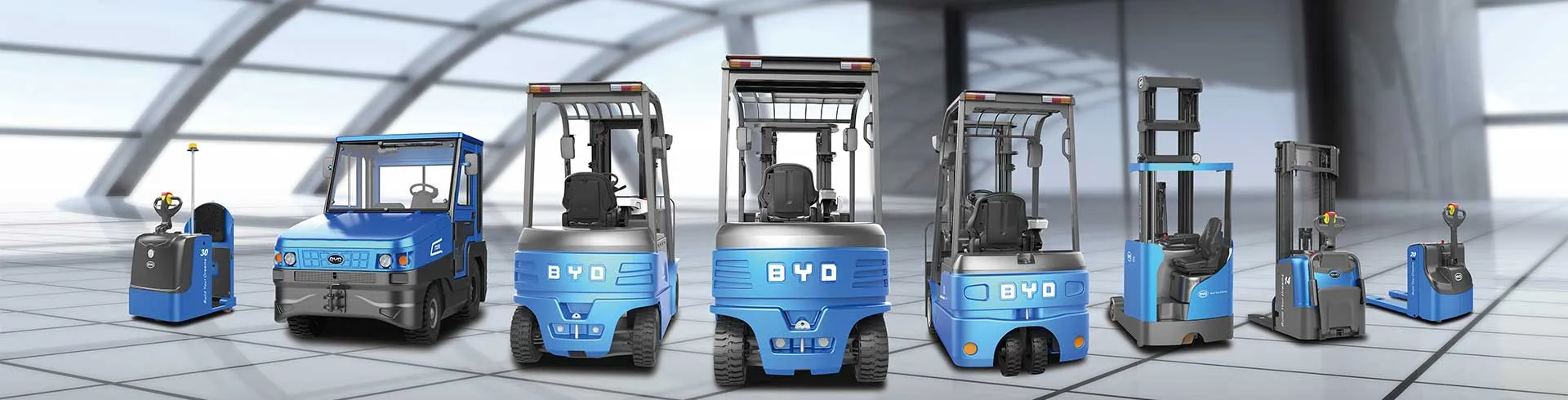
Dans les scénarios de stockage et de manutention quotidiens, les chariots élévateurs électriques à contrepoids sont largement utilisés comme équipement de manutention. De nombreux utilisateurs sont sujets à la confusion quant aux différences d'attributs entre les modèles à trois et à quatre points lors de la sélection des modèles. Nous utilisons le chariot élévateur électrique CPD18S de 1,8 tonne à haute circulation sur le marché comme référence pour démonter les différentes caractéristiques des deux types de produits.

différence de structure du noyau

Différence du système de direction

Le modèle à trois pivots adopte principalement la conception de direction à une roue de la roue arrière, qui offre une flexibilité de direction globale plus élevée, et la couverture de la trajectoire des roues pendant la rotation est plus petite, ce qui n'occupera pas trop d'espace d'activité excédentaire. Le modèle à quatre pivots adopte la conception de direction synchrone à deux roues arrière, qui a une répartition de la force plus uniforme pendant le processus de direction, une rétroaction plus fluide du fonctionnement de la direction dans différentes conditions de travail et un seuil plus bas pour que les opérateurs puissent commencer.

Prise en charge de la différence de mise en page

Les trois points de support du modèle à trois pivots sont triangulaires et stables, l'ensemble de la carrosserie n'a pas besoin d'occuper un espace de contrepoids redondant, la structure du châssis est plus compacte et la taille globale de la carrosserie peut être contrôlée dans une plage plus petite. Les quatre points de support du modèle à quatre pivots sont uniformément répartis dans les quatre coins du châssis de la carrosserie, la couverture globale du châssis est plus grande, l'espace de disposition du module de contrepoids est plus suffisant et la conception du contrepoids du véhicule est plus flexible.

Écart réel du rendement au travail

Différences de roulements et de stabilité

Sur la base des paramètres du modèle CPD18S, le rayon de braquage minimal du modèle à trois points sous le même tonnage peut être contrôlé dans une plage plus petite à vide, et la stabilité de fonctionnement de la surface de route dure et plate sous pleine charge peut répondre aux besoins conventionnels. Le modèle à quatre points a un support latéral plus abondant, et ses performances sont plus stables dans la scène d'empilement d'une surface de route inégale et d'une force latérale, et il peut également maintenir la stabilité de la carrosserie en cas de force latérale soudaine.

Différence entre les scénarios d'application

Le modèle à trois pivots est plus adapté aux entrepôts de stockage denses à canaux étroits, en particulier aux scénarios d'empilage de haut niveau avec une largeur de canal de moins de deux mètres. Il peut faire la navette de manière flexible entre les étagères pour terminer les opérations de picking et de déchargement sans rayer les étagères. Le modèle à quatre pivots est plus adapté aux scénarios de manutention à grand débit des sites durcis extérieurs et des étagères moyennes et basses. Il a un degré d'adaptation plus élevé pour les opérations qui réimpriment fréquemment des marchandises plus lourdes, et les performances des opérations haute fréquence à long terme sont plus stables. Lorsque les utilisateurs choisissent un modèle, ils peuvent juger de manière exhaustive la largeur du canal de leur propre entrepôt, les conditions de la surface de la route de travail et les exigences conventionnelles en matière de roulement. La sélection d'un équipement adapté à leur propre rythme de fonctionnement peut efficacement améliorer l'efficacité globale de manutention.

WhatsApp

WeChat

Contactez-nous

Envoyer une demande

We use cookie to improve your online experience. By continuing to browse this website, you agree to our use of cookie.

Cookies

Please read our Terms and Conditions and this Policy before accessing or using our Services. If you cannot agree with this Policy or the Terms and Conditions, please do not access or use our Services. If you are located in a jurisdiction outside the European Economic Area, by using our Services, you accept the Terms and Conditions and accept our privacy practices described in this Policy.
We may modify this Policy at any time, without prior notice, and changes may apply to any Personal Information we already hold about you, as well as any new Personal Information collected after the Policy is modified. If we make changes, we will notify you by revising the date at the top of this Policy. We will provide you with advanced notice if we make any material changes to how we collect, use or disclose your Personal Information that impact your rights under this Policy. If you are located in a jurisdiction other than the European Economic Area, the United Kingdom or Switzerland (collectively “European Countries”), your continued access or use of our Services after receiving the notice of changes, constitutes your acknowledgement that you accept the updated Policy. In addition, we may provide you with real time disclosures or additional information about the Personal Information handling practices of specific parts of our Services. Such notices may supplement this Policy or provide you with additional choices about how we process your Personal Information.


Cookies

Cookies are small text files stored on your device when you access most Websites on the internet or open certain emails. Among other things, Cookies allow a Website to recognize your device and remember if you've been to the Website before. Examples of information collected by Cookies include your browser type and the address of the Website from which you arrived at our Website as well as IP address and clickstream behavior (that is the pages you view and the links you click).We use the term cookie to refer to Cookies and technologies that perform a similar function to Cookies (e.g., tags, pixels, web beacons, etc.). Cookies can be read by the originating Website on each subsequent visit and by any other Website that recognizes the cookie. The Website uses Cookies in order to make the Website easier to use, to support a better user experience, including the provision of information and functionality to you, as well as to provide us with information about how the Website is used so that we can make sure it is as up to date, relevant, and error free as we can. Cookies on the Website We use Cookies to personalize your experience when you visit the Site, uniquely identify your computer for security purposes, and enable us and our third-party service providers to serve ads on our behalf across the internet.

We classify Cookies in the following categories:
 ●  Strictly Necessary Cookies
 ●  Performance Cookies
 ●  Functional Cookies
 ●  Targeting Cookies


Cookie List
A cookie is a small piece of data (text file) that a website – when visited by a user – asks your browser to store on your device in order to remember information about you, such as your language preference or login information. Those cookies are set by us and called first-party cookies. We also use third-party cookies – which are cookies from a domain different than the domain of the website you are visiting – for our advertising and marketing efforts. More specifically, we use cookies and other tracking technologies for the following purposes:

Strictly Necessary Cookies
These cookies are necessary for the website to function and cannot be switched off in our systems. They are usually only set in response to actions made by you which amount to a request for services, such as setting your privacy preferences, logging in or filling in forms. You can set your browser to block or alert you about these cookies, but some parts of the site will not then work. These cookies do not store any personally identifiable information.

Functional Cookies
These cookies enable the website to provide enhanced functionality and personalisation. They may be set by us or by third party providers whose services we have added to our pages. If you do not allow these cookies then some or all of these services may not function properly.

Performance Cookies
These cookies allow us to count visits and traffic sources so we can measure and improve the performance of our site. They help us to know which pages are the most and least popular and see how visitors move around the site. All information these cookies collect is aggregated and therefore anonymous. If you do not allow these cookies we will not know when you have visited our site, and will not be able to monitor its performance.

Targeting Cookies
These cookies may be set through our site by our advertising partners. They may be used by those companies to build a profile of your interests and show you relevant adverts on other sites. They do not store directly personal information, but are based on uniquely identifying your browser and internet device. If you do not allow these cookies, you will experience less targeted advertising.

How To Turn Off Cookies
You can choose to restrict or block Cookies through your browser settings at any time. Please note that certain Cookies may be set as soon as you visit the Website, but you can remove them using your browser settings. However, please be aware that restricting or blocking Cookies set on the Website may impact the functionality or performance of the Website or prevent you from using certain services provided through the Website. It will also affect our ability to update the Website to cater for user preferences and improve performance. Cookies within Mobile Applications

We only use Strictly Necessary Cookies on our mobile applications. These Cookies are critical to the functionality of our applications, so if you block or delete these Cookies you may not be able to use the application. These Cookies are not shared with any other application on your mobile device. We never use the Cookies from the mobile application to store personal information about you.

If you have questions or concerns regarding any information in this Privacy Policy, please contact us by email at . You can also contact us via our customer service at our Site.


WhatsApp avatar

Click to Chat.

Im online now.

Hey, my name is Tim. The CPO of JXD, how can I assist you today?

WhatsApp Us

WhatsApp us