
 简体中文
简体中文 Deutsch
 日本語
日本語 한국어
한국어 Tiếng Việt
 Русский
 ไทย
ไทย Bahasa Indonesia
 Bahasa Melayu
 Filipino
 لالعربية
 Français
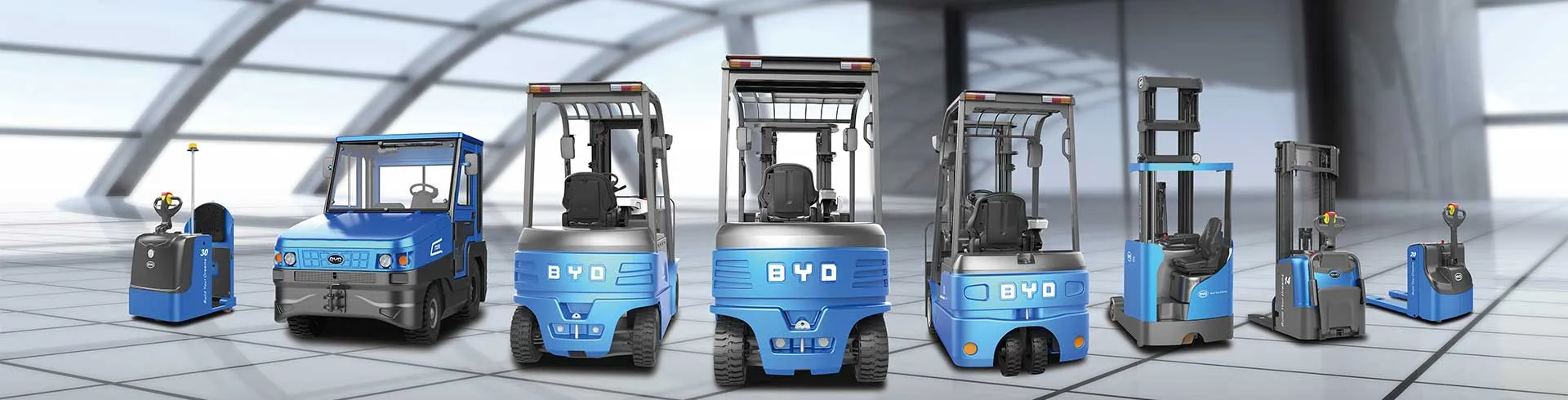
The warehousing logistics and workshop transshipment working conditions of the feed industry have the typical characteristics of high dust, high load, long-term continuous operation, strict hygiene standards, and indoor and outdoor mixed operations. Traditional handling equipment generally has problems such as insufficient working condition adaptability, high operating costs, poor environmental protection adaptability, and high equipment failure rate. BYD lithium-ion forklifts rely on mature hardware configuration and battery technology to specifically match the operation needs of the feed industry. At this stage, they are widely used in equipment upgrade scenarios of feed enterprises. This paper objectively expounds the operation pain points, adaptation solutions and application value based on the general real working conditions of the feed industry. There is no fictional content.
First, the core scenario of forklift operation in the feed industry
The forklift operation in the production and logistics of feed enterprises is highly fixed, and the general scenarios in the whole industry are mainly divided into four categories, which are also the core scenarios of high-frequency use and loss concentration of forklifts:
1. Raw material warehousing and transshipment
: Corn, soybean meal, bran and other bulk, bagged raw materials truck loading and unloading, factory short-distance transshipment, cargo tonnage, handling frequency is very high.
2. Workshop production line replenishment
In the production workshop, there is a round-trip supply of raw materials and material turnover, and the operating space is relatively narrow, mostly indoor closed operations.
3. Finished product stacking storage
The high-level stacking, neat stacking, and storage shifting of bagged and barrel finished feed require high equipment stability and lifting accuracy.
4. Finished products are shipped out of the warehouse and loaded on the truck.
: The finished feed is loaded and unloaded in batches, mostly for outdoor open-air operation, which needs to be adapted to complex road conditions such as ramps and uneven roads, and multi-shift continuous operation.
Second, the common use pain points of traditional forklifts in the feed industry
At present, most domestic feed mills are still using traditional fuel forklifts or ordinary lead-acid electric forklifts, which are limited by equipment performance and combined with the special working conditions of feed. There are generally five core pain points, which are also long-standing production problems in the industry.
(1) Environmental protection is not up to standard, and there is a risk of food safety and compliance
Feed belongs to the agriculture-related food industry, and the production workshop and storage warehouse area have strict requirements on environmental hygiene. Traditional fuel forklifts continue to produce exhaust gas, exhaust gas and oil fume during operation, which cannot spread rapidly in the closed workshop. It is easy to adhere to the surface of raw materials and finished feeds, causing material pollution and affecting product quality. At the same time, the current environmental protection supervision is becoming increasingly strict. The problems of excessive exhaust emissions of fuel equipment in the factory area and disturbing the people will bring the risk of compliance and punishment to enterprises, and cannot adapt to the basic requirements of green production and clean operations in the feed industry.
(2) Weak adaptability to working conditions, high equipment failure rate and short lifespan
The whole process of feed production is accompanied by a large amount of raw material dust, and the humidity in the workshop is high, which belongs to the typical dust and humid working conditions. The engine, oil circuit, and air intake system of traditional fuel forklifts are prone to dust inhalation, which causes failures such as filter element blockage, oil circuit carbon deposition, and power attenuation; ordinary electric forklifts have limited electrical control and line protection levels, and the dust is prone to short circuit, leakage, and poor contact after moisture. At the same time, high-frequency handling of feed goods with heavy load, frequent climbing and turning in the factory area, limited stability and shock absorption performance of traditional equipment frames, and long-term high-intensity operations are prone to component wear, equipment cards, and high repair frequency. Equipment shutdown can easily affect the continuous operation of the production line.
(III) Comprehensive operating costs remain high
From the perspective of the cost of full life cycle use, the economy of traditional equipment is weak. The daily fuel consumption cost of fuel forklifts is high, and various consumables such as oil, machine filter, air filter, spark plug need to be replaced regularly, and the annual maintenance expenditure is high. Ordinary lead-acid electric forklifts have shortcomings such as charging time and battery life, making it difficult to adapt to multi-shift operation mode. At the same time, the battery cycle life is short. It needs to be replaced as a whole after 2-3 years of use, and the later replacement cost is high. The shutdown loss and maintenance labor costs caused by frequent equipment failures further increase the production and operation burden of enterprises.
(IV) Operational efficiency is limited, unable to adapt to continuous production requirements
The feed industry generally adopts 24-hour uninterrupted production and multi-shift rotation operation mode. Traditional fuel forklifts have slow cold start response, insufficient performance of heavy-duty climbing power, and cumbersome start-stop operation process; ordinary lead-acid forklifts can be charged for 8-10 hours, with limited battery life and cannot be quickly replenished. Enterprises need to be equipped with multiple equipment rotation operations, with low equipment utilization and high labor costs. At the same time, traditional forklifts have average lifting and driving stability, and high-level stacking is prone to deviation, which affects the regularity of storage stacking and overall transshipment efficiency.
(5) Poor operating experience and potential safety hazards
The noise and vibration of traditional fuel forklifts are too large, and the driver is prone to fatigue after long-term operation, which increases the probability of misoperation. At the same time, the oil circuit and circuit of fuel forklifts are prone to oil leakage and spontaneous combustion after aging. In the dust-intensive feed workshop, the fire safety risk is more prominent. The safety configuration of ordinary electric forklifts is relatively basic, and it lacks functions such as anti-skid, turning speed reduction, and overload protection. It has general stability when operating in a narrow workshop and turning under heavy load, and is prone to safety problems such as equipment collision and cargo dumping.
III. BYD forklifts' adaptation solutions for pain points in the feed industry
Based on the core working conditions of high dust, heavy load and high frequency, continuous operation, and high cleanliness requirements in the feed industry, BYD forklifts rely on self-developed lithium iron phosphate power batteries, vehicle protection technology, and industrial-grade chassis design to specifically solve various pain points in the industry and adapt to the whole scene logistics operations of feed enterprises.
(1) Zero emission and low noise, meeting clean production and environmental compliance
BYD's lithium-ion forklift has no exhaust gas, no exhaust gas, and no oil pollution throughout the operation, which can effectively avoid fuel pollution problems, ensure the cleanliness of feed raw materials and finished products, and adapt to the hygiene production standards of the feed industry. The equipment operates with lower noise and vibration, which can optimize the working environment of the workshop, has no exhaust gas emissions, and meets the current environmental protection control requirements, helping enterprises reduce the risk of environmental compliance.
(2) High protection and corrosion resistance, suitable for dust, humidity and harsh working conditions
In view of the dust and humidity working conditions of the feed factory, the core electronic control, motor and connector of BYD forklift truck are all designed with high-level dustproof and waterproof closed protection, which can effectively block the intrusion of dust and water vapor and reduce the occurrence of short circuits, cards, malfunctions and shutdowns. The frame of the whole vehicle adopts anti-corrosion and wear-resistant coating, which can withstand long-term moisture and dust erosion, effectively reduce the frequency of equipment repair, prolong the service life of the equipment, and adapt to the harsh working environment of the feed workshop.
(III) Cost reduction throughout the life cycle, significantly reducing operating expenses
BYD forklifts are equipped with self-developed lithium iron phosphate batteries, which do not need to replace oil, filter elements, oil circuits and other consumables. The daily maintenance workload is less, which can effectively reduce the annual maintenance cost. The power energy consumption cost of equipment is much lower than that of fuel equipment, and the energy consumption cost per unit operation is about 1/3 of that of fuel forklifts. At the same time, the battery cycle life exceeds 4000 times, and it can be used stably for 8-10 years under normal working conditions. There is no need to replace the battery halfway, which reduces the investment in later equipment. The cost advantage of the whole life cycle is obvious.
(4) Fast charging and long battery life, suitable for 24-hour continuous high-intensity operation
The power output of the equipment is stable, the power of heavy-load climbing and high-speed transfer process is stable, and there is no obvious power attenuation. It is suitable for heavy-load, high-frequency and complex road conditions operation scenarios in the feed industry. Support short-term fast charging function, which can use the operation gap to complete the replenishment, adapt to the needs of multi-shift continuous operation, and do not need multiple equipment rotation to improve the utilization rate of equipment. The equipment has sensitive power response, stable start and stop, and accurate lifting, which can improve the efficiency of finished product stacking and material transfer, and match the uninterrupted production mode of feed enterprises.
(5) Multiple safety configurations to avoid safety risks in working conditions
BYD lithium iron phosphate battery has the characteristics of high temperature resistance, short circuit protection and spontaneous combustion prevention, which can reduce the fire safety hazard in dust environment. The whole vehicle is equipped with conventional safety configurations such as automatic speed reduction for turning, overload protection, emergency braking, and reversing warning. The equipment chassis is stable and the center of gravity is reasonable. It has good stability in narrow space turning, high stacking, and heavy-duty driving scenarios, which can reduce safety accidents such as cargo dumping and equipment collision. With ergonomic operation design, it can relieve driver fatigue and reduce the probability of human operation errors.
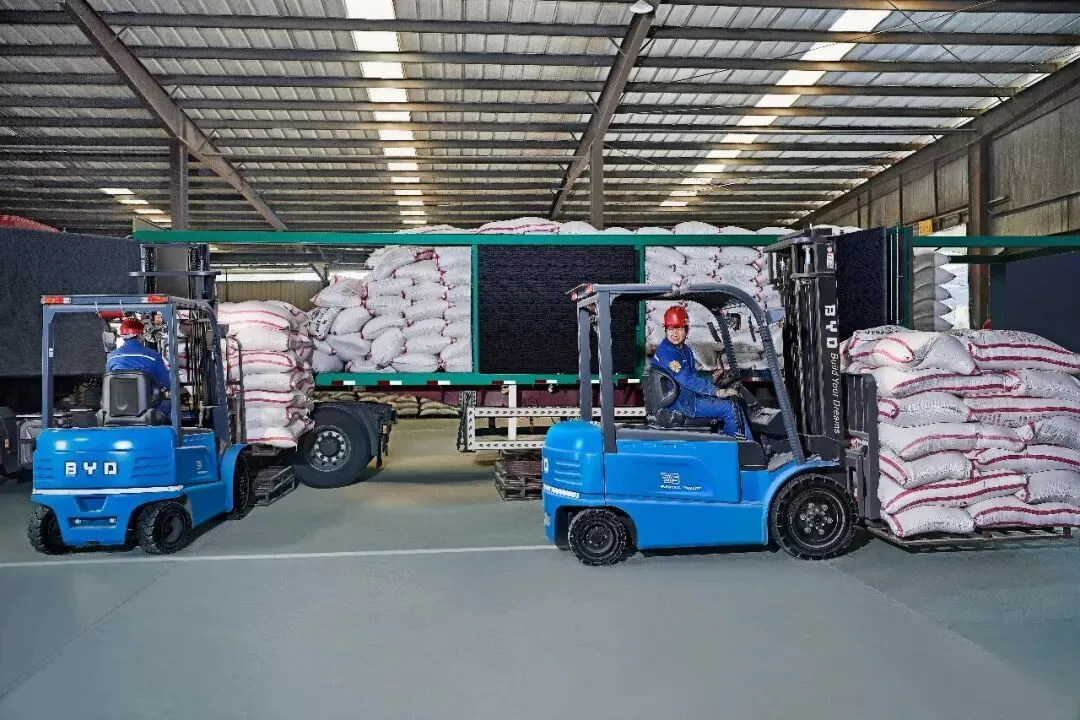
IV. Summary of industry-wide application value
In response to the exclusive working conditions and long-term operating pain points of the feed industry, BYD lithium-ion forklifts are
Environmental compliance, equipment durability, cost reduction and efficiency, safe production
Four aspects are optimized and upgraded to make up for the shortcomings of traditional handling equipment. Relying on the product characteristics of high protection, long battery life, low maintenance, and zero emissions, it can be used as an adaptation plan for the green and efficient upgrading of logistics handling equipment in the feed industry to improve the industry problems such as substandard environmental hygiene, high equipment failure rate, high operating costs, insufficient operating efficiency, and many potential safety hazards of feed enterprises.


