简体中文
简体中文 Deutsch
 日本語
日本語 한국어
한국어 Tiếng Việt
 Русский
 ไทย
ไทย Bahasa Indonesia
 Bahasa Melayu
 Filipino
 لالعربية
 Français
First, the characteristics of handling conditions in the glass industry
The logistics of the glass industry covers scenes such as incoming material loading and unloading, workshop turnover, finished product packing and shipment, and the overall working conditions have distinct characteristics:
Moderate load
The handling load is concentrated in the 2.5T-3.5T range, and different operation scenarios match the corresponding tonnage handling equipment.It takes a lot of time.
The industry generally adopts a three-shift production model, and some enterprises implement 24-hour continuous operation. Forklifts need to support long-term uninterrupted operation.Multiple job scenarios
Handling work covers both indoor workshops and outdoor storage areas, loading areas, and other areas.Strict transshipment requirements
Glass products are vulnerable to damage, and the need for lean production management is compounded. Factory logistics has high standards for transshipment efficiency and cargo protection.
Second, the current situation of the use of industrial handling equipment
At present, the glass industry has basically completed the upgrade of "oil to electricity". The on-site handling equipment is mainly electric forklifts, electric tractors, and pallet trucks, of which lead-acid battery forklifts account for a high market share. There are some objective limitations in the long-term use of this type of equipment:
More daily DevOps flow
Batteries require regular addition of distilled water and electrolyte preparation, making daily maintenance more cumbersome.The supporting investment is high
Charging lead-acid batteries takes a long time, and most enterprises need to provide additional backup batteries. At the same time, battery operation and charging process will generate acid mist and hydrogen, so enterprises need to build a dedicated charging site and arrange for special management to increase infrastructure and labor costs.Limited life cycle
Lead-acid batteries have a short lifespan and require regular replacement, which increases long-term operating expenses.
Based on the development needs of the industry, glass companies expect to choose handling equipment that is easy to operate and maintain, has reasonable energy consumption, is environmentally friendly, has stable operation, and provides complete services.
III. BYD forklift customized handling solutions
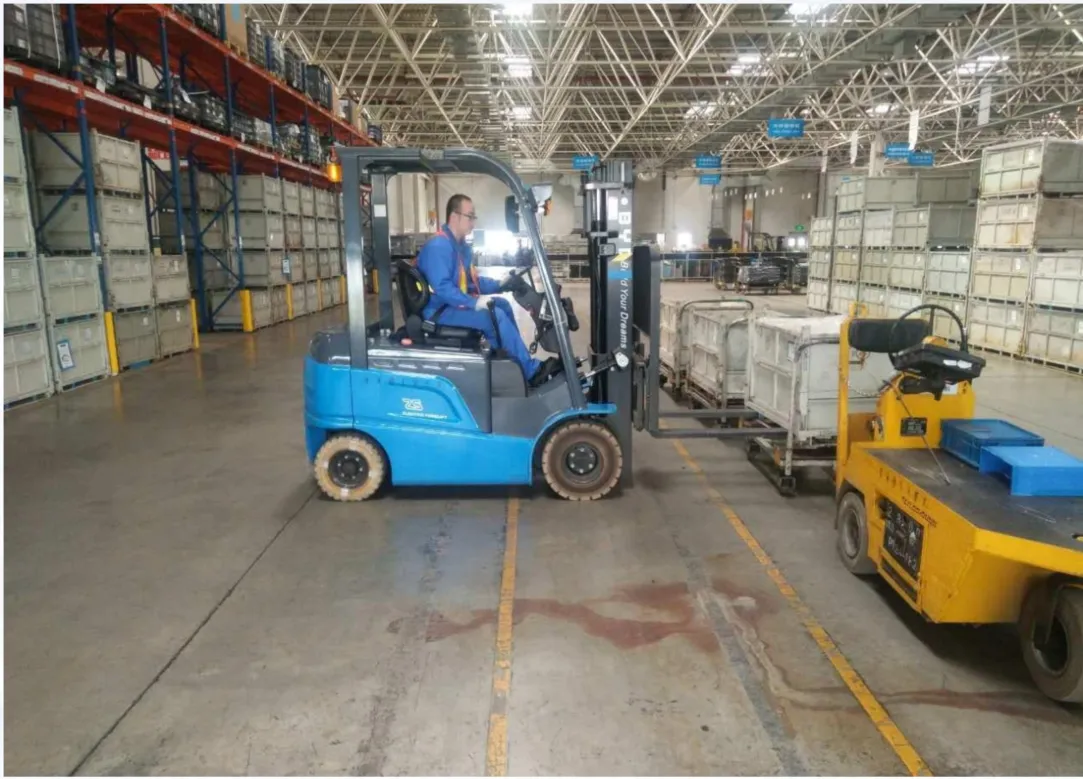
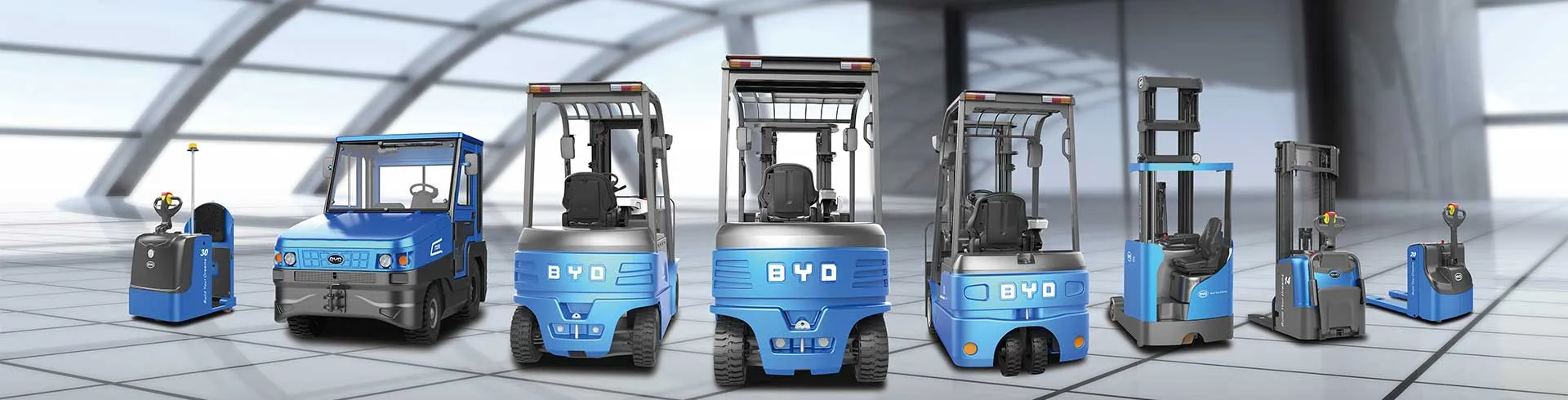
Combining the working conditions of the glass industry with the actual needs of enterprises, BYD has launched a full range of handling equipment including counterbalanced forklifts, tractors, front-moving trucks, and pallet trucks, providing supporting solutions from product selection, hardware configuration, safety design, and after-sales services.
(1) Scenario-based product selection
Combine different operating areas and load requirements to match corresponding models, and adapt to the whole process of handling:
1. Incoming loading and unloading scenarios (load 2.5T): 3.0T/3.5T counterweight forklifts are recommended;
2. Raw material workshop (load 2.5T): 3.0T counterbalanced forklift and 3.0T-5.0T electric tractor are recommended.
3. Melting workshop (load 2.5T): recommended 2.5T/3.0T counterweight forklifts, tractors and 2.0T pallet trucks;
4. Forming workshop (load 2.5T): 2.5T/3.0T counterbalanced forklift and 2.0T pallet truck are recommended.
The core features of the main product: the whole series is equipped with lithium iron phosphate batteries, the battery does not require daily maintenance, supports fast charging and recharging, and can be used at any time, with zero emissions during operation; the vehicle comes standard with a number of safety functions, and can also be equipped with warning lights, car fans and other accessories.
(2) Battery configuration and operating cost reference
1. Battery and battery life parameters
| Model | load | Recommended battery capacity | matching charger | battery life |
| Counterbalanced Forklift | 2.5T/3.0T | 270Ah/560Ah | 200A | 8-10 hours |
| Tractor | 3.0T/5.0T | 130Ah/270Ah | 100A | 6-8 hours |
| Pallet truck | 2.0T | 130Ah | 100A | 6-8 hours |
2. Energy consumption and comprehensive cost comparison
Data calculation description
: The following data is based on the daily operation of the vehicle for 20 hours and 30 days per month, and the electricity price is calculated at 0.8 yuan/kWh. The data is derived from the actual measurement of the internal working conditions of the BYD forklift, which is for reference only. Taking the 2.5T model as an example, the BYD electric forklift consumes 4.5 kWh of electricity per hour, and the monthly electricity fee is 2,400 yuan; the lead-acid battery forklift of the same tonnage consumes 5 kWh of electricity per hour, and the monthly electricity fee is 3,180 yuan. Relying on the advantages of charging and discharging efficiency, a single BYD forklift can reduce electricity expenses by a certain amount
Five-year comprehensive operating cost comparison
| Statistical project | BYD 2.5T electric forklift | 2.5T lead-acid battery forklift |
| Five-year total cost of energy consumption | 132,000 yuan. | It's 174,900 yuan. |
| Five-year total maintenance cost | 48,000 yuan. | 50,000 yuan. |
| Five-year total operating cost | 180,000 yuan. | It's 347,400 yuan. |
3. Comparison of battery usage characteristics
BYD lithium iron phosphate batteries do not require daily maintenance, no need to build a special charging site, charging time is 1-2 hours, and the battery life can reach 10 years; lead-acid batteries need regular maintenance, equipped with spare batteries and special charging rooms, charging time is 4-5 hours, and the battery life cycle is about 2-3 years. The above is an objective comparison of the use characteristics of the two types of batteries.
(III) Security configuration and customized design
1. Basic safety features
The vehicle is equipped with functions such as slope protection, overload protection, low cylinder buffer, vehicle power-off protection, low power protection, and turning speed limit to ensure operation safety.2. Personalized customization
: Customized door frame, fork specifications can be customized according to needs, and professional attachments such as side shifters and pitch-adjusting forks can be selected. At the same time, it supports the installation of fully enclosed cabs, panoramic rearview mirrors, stroboscopic lights, fire extinguishers, grounding conductive chains and other accessories to adapt to indoor and outdoor complex operating environments and optimize the operation experience.IV. Summary of the plan
In response to the glass industry's heavy-duty, long-term operation, and indoor-outdoor mixed working conditions, BYD's lithium iron phosphate series forklifts, with their maintenance-free batteries, quick energy replenishment, low energy consumption, and zero emissions, can help enterprises simplify operation and maintenance work, reduce infrastructure investment, and control long-term operating costs.
Combined with a wealth of customized configurations and a complete full-process service system, BYD forklifts can cover the entire process handling needs of glass enterprises for incoming materials, production, warehousing, and shipment, making them a practical handling solution suitable for the development of the glass industry.