
 简体中文
简体中文 Deutsch
 日本語
日本語 한국어
한국어 Tiếng Việt
 Русский
 ไทย
ไทย Bahasa Indonesia
 Bahasa Melayu
 Filipino
 لالعربية
 Français
First, the characteristics of the sheet metal industry handling conditions
The sheet metal industry handling business covers the whole process of raw materials, auxiliary materials, production work in progress, and finished products. The operation content includes loading and unloading, material transfer, stacking, finished product shipment, etc. The overall working conditions are complex and the operation intensity is relatively large. The specific characteristics are as follows:
heavy workload
: Raw material loading and unloading stacking, production line work in progress, finished product warehousing and shipment scenes, the material load generally reaches more than 3T, and the whole process is mainly heavy-duty operations.Long working time
The industry generally adopts a three-shift production model, with forklifts operating for up to 20 hours or more in a single day. Equipment needs to meet the requirements of long-term continuous operation.Fixed working environment
The handling work is mainly completed in indoor workshops and warehouses, and the working space is relatively closed.The scene environment is harsh
: During the processing of sheet metal, a large amount of sawdust and broken wood will be generated, and with the use of powdery accessories in production, there is a lot of dust in the workshop, which requires high dust resistance and durability of forklifts.
Second, the current situation of sheet metal industry handling and industry pain points
At present, domestic plate enterprises mostly use domestic internal combustion counterbalanced forklifts for handling work, and only a small number of enterprises are equipped with electric forklifts. Internal combustion forklifts can be adapted to the heavy-duty working conditions of the industry, but combined with the current production and operation needs and environmental protection policy requirements, this type of equipment gradually presents many problems during use, which brings multiple pressures to the operation of enterprises.
(1) The high cost of operating energy consumption
Taking the mainstream 3.5T internal combustion forklift truck in the market as an example, combined with the conventional operation mode of the industry, the vehicle works 20 hours a day, 30 days a month, and consumes 3 liters of fuel per hour. According to the oil price of 6 yuan/liter, the daily fuel cost is 360 yuan, and the monthly fuel cost of a single vehicle can reach 10,800 yuan. Long-term use will continue to increase the operating expenses of the enterprise.
(2) Exhaust gas and noise affect the workshop environment
Diesel engines emit hydrocarbons, carbon monoxide, sulfur dioxide, soot particles, formaldehyde and other substances when they work. According to the relevant data of the World Health Organization, diesel engine exhaust has a high health risk. At the same time, internal combustion forklifts generate a lot of noise and heat during operation, which not only affects the working environment in the closed indoor workshop, but also affects the health of the staff. At this stage, the environmental protection control policy of industrial vehicles continues to tighten, and exhaust emissions have become a key concern of sheet metal enterprises.
(3) The equipment maintenance workload is large, and the maintenance cost is not low
The mechanical structure of internal combustion forklifts is relatively complex, and the equipment is prone to failure under the conditions of heavy load and dust in the plate industry. Core components such as engines need regular maintenance work, coupled with the limited quality assurance cycle of core accessories and high purchase prices, which not only increases the equipment maintenance time and cost, but also may affect the normal production rhythm of enterprises.
(4) The operation experience is average, and the equipment functions need to be upgraded
The high temperature, smoke, noise and other problems caused by the operation of internal combustion forklifts reduce the comfort of indoor operations. At the same time, the intelligent configuration of traditional handling equipment is too small, which makes it difficult to further improve the overall operation efficiency and cannot fully match the development needs of modern plate enterprises.
In light of the current situation of the industry, the sheet metal industry is looking forward to the introduction of new handling equipment that can adapt to long-term heavy-duty operations, low energy consumption, green environmental protection, stable operation, and good user experience.
III. Exclusive solutions for BYD forklifts
Combining the full-scene operation requirements of the sheet metal industry, on-site working conditions, and the development demands of enterprises to reduce costs and increase efficiency and green production, BYD has launched a complete set of handling solutions with 3.5T and 4.0T electric counterweight forklifts as the core, from product selection, hardware configuration, customized design, safety protection, ergonomics and after-sales services six dimensions to match the actual use needs of the industry.
(1) Precise product selection
For the three core operation areas of raw material warehouse, production line and finished product warehouse (average daily operation of 20 hours and load of more than 3T), it is recommended to use
3.5T Electric Counterbalanced Forklift
For large tonnage and heavy load scenarios, optional
4.0T electric counterbalanced forklift
Fully cover the entire process of sheet metal handling.
(2) Core hardware configuration, suitable for heavy load and long-term working conditions
High-capacity lithium iron phosphate battery with long battery life and low energy consumption
The equipment comes standard with a 560Ah large-capacity lithium iron phosphate battery, which can last up to 8-10 hours. With a 200A high-current charging cabinet, it supports quick replenishment and can be used as needed. The staff can use the rest gap to complete the vehicle charging, fully meeting the needs of three shifts for 20 hours of continuous operation.
data description
The following estimates are based on the regular working conditions of the sheet metal industry. Vehicles operate for 20 hours a day and 30 days a month. The electricity price is 0.8 yuan/kWh and the oil price is 6 yuan/liter. The data comes from the internal working conditions measurement of BYD forklifts and industry research, for reference only.
Combined with the calculated data, the 3.5T BYD electric forklift consumes 6 kWh of electricity per hour, with a daily electricity bill of 96 yuan and a monthly electricity bill of 2880 yuan per unit. Compared with internal combustion forklifts of the same tonnage, electric models have obvious advantages in energy consumption.
data description
The following five-year cost estimate is based on the above unified working conditions, and the maintenance cost is taken from the conventional quotation range of the industry. The data is for reference only.
Looking at the comprehensive five-year service cycle, the five-year energy consumption cost of a single BYD electric forklift is 158,400 yuan, and the maintenance cost is 48,000 yuan, for a total of 206,400 yuan; the five-year energy consumption cost of an internal combustion forklift of the same tonnage is 594,000 yuan, and the maintenance cost is 75,000 yuan, for a total of 669,000 yuan. Comprehensive accounting, a single electric forklift can reduce a total of 462,600 yuan (excluding vehicle procurement costs) in five years.High-power power system, stable and reliable operation
The 3.5T model is equipped with 21.5KW walking motor and 24KW lifting motor, with a driving speed of 15/16Km/h, a lifting speed of 380/450mm/s, and a climbing degree of 15/20%; the 4.0T model is equipped with double 15KW walking motor and 25.4KW lifting motor, with a driving speed of 18/18Km/h, a lifting speed of 350/450mm/s, and a climbing degree of 15/20%. The output of the whole power system is stable, which can meet the heavy-duty handling and stacking operations of more than 3T. The whole vehicle is equipped with BYD's self-developed three-electric system, and is equipped with core components such as high-quality hydraulic, drive and control of the mainstream industry. It can adapt to complex working conditions such as dust and heavy load.
(III) Industry-customized structural design
Combined with the special working conditions of the plate workshop to complete the structural optimization of special projects, improve equipment adaptability and operation stability:
Custom door racks and forks
It adopts a 4-meter secondary gantry, which is fixed on the side of the fork; it is equipped with a 1.5-meter wide fork rack, and the inner spacing of the fork has a large adjustable range, which can be adapted to a variety of specifications for plate handling.Counterweight upgrade
Optional 380KG high-voltage counterweight to enhance stability during heavy-duty operations.Comprehensive dust protection design
: According to the characteristics of wood chips and dust in the workshop, the key components such as motors, hydraulic components, and line connectors are sealed and dustproof to reduce the probability of failure.
(IV) Multiple safety protection functions
The vehicle is equipped with a number of safety configurations to avoid the safety risks caused by heavy loads and intensive indoor operations, including slope protection, overload protection, low cylinder buffer, vehicle power-off protection, low battery protection, turning speed limit, OPS function seats, etc., to fully ensure the safety of vehicles, goods and operators.
(5) Ergonomic optimization to enhance the working experience
For indoor long-term operation scenarios, the vehicle supports a number of user-friendly configuration options, including a closed cab, warning lights, blue lights, car fans, reversing armrests, spherical mirrors, storage boxes, fire extinguisher brackets, etc., to improve the working environment in the workshop, relieve worker fatigue, and help improve work efficiency.
IV. Landing case display
This set of forklift handling solutions has been applied in many sheet metal enterprises, with stable on-site operation and recognition from cooperative customers. Typical cooperative customers are as follows:
Wood industry: 3.5T counterbalanced forklift is selected to serve the whole scene of raw material warehouses, production workshops, and finished product warehouses.
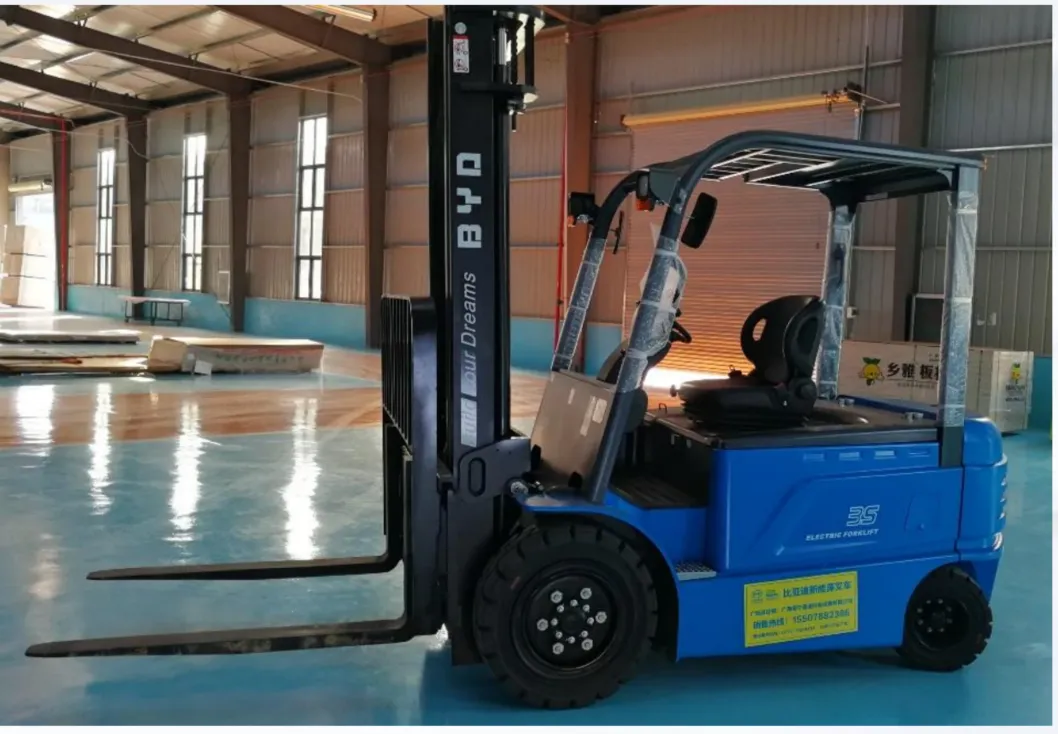
At the same time, BYD forklift products are also widely used in logistics, food and beverage, automobile manufacturing, steel, home appliances, building materials, and other industries. The product performance has been verified in various fields.
V. Program summary
In response to the core working conditions of heavy load, long-term operation, high dust, and closed working space in the sheet metal industry, as well as the high energy consumption of traditional internal combustion forklifts, the impact of exhaust noise on the environment, and the heavy maintenance workload, BYD electric forklifts rely on their self-developed lithium iron phosphate batteries, high-power power systems, industry-customized structures, multiple safety configurations, and humanized design to help enterprises achieve cost reduction and efficiency, green production, stable equipment operation, and optimized operation experience.
With a complete long-cycle quality assurance and fast after-sales services system, BYD forklifts can replace traditional internal combustion forklifts and are a professional handling solution suitable for the development needs of the sheet industry.


