
 简体中文
简体中文 Deutsch
 日本語
日本語 한국어
한국어 Tiếng Việt
 Русский
 ไทย
ไทย Bahasa Indonesia
 Bahasa Melayu
 Filipino
 لالعربية
 Français
The core use appeal of forklifts in cold storage scenarios
Stability requirements for power components
Cold storage and warehousing have been in a low temperature and high humidity environment for a long time, and some operation areas still have long-term frost and ice conditions. When ordinary electric forklifts are used in such scenarios, they are prone to problems such as rapid power decay and operation interruption, which directly affect the overall operation progress. Therefore, in the selection stage, it is necessary to ensure that the core power components are adapted to the low temperature environment without significant performance fluctuations.
Body protection performance requirements
The high humidity and low temperature environment inside the cold storage will accelerate the aging and corrosion rate of ordinary rubber parts and metal movable parts. When selecting a suitable forklift, the operator should pay attention to the sealing level of the vehicle and the material properties of the exposed parts, and reduce the subsequent maintenance frequency as much as possible to control long-term operating costs.
The actual performance of low temperature operation of the reference model
Power output adaptation performance
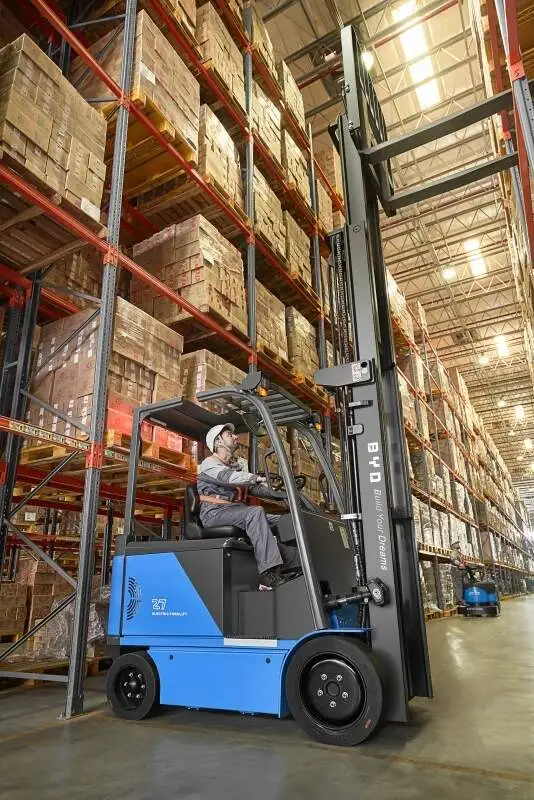
The 2-ton counterweight electric forklift referred to this time has been specially designed for low temperature scenarios. The intelligent temperature control management system can maintain stable operation in a conventional low-temperature cold storage environment, with smooth power output and a reasonable range of battery life attenuation, which can meet the needs of continuous operation in cold storage throughout the day.
Weathering performance of vehicle components
The door frame movable joints and sealing rubber parts of this forklift are all made of low temperature resistant materials, and it is not easy to cause card failure in high humidity and low temperature environments for a long time. Corresponding sealing protection is made in the circuit area of the whole vehicle to avoid frost and meltwater entering the line and causing failure.
Precautions for daily use of forklifts in low temperature scenarios
Parking management points
During the daily operation, if the forklift does not need to be continuously put into use, it is recommended to park the vehicle in a specially set room temperature transition area and do not stay in the deep and low temperature operation area for a long time to reduce unnecessary component aging and wear.
Regular maintenance direction
In the daily maintenance stage, it is necessary to focus on checking the frost residue of the moving parts of the gantry and the circuit interface, and promptly remove water and lubricate, and check potential minor faults as soon as possible to ensure the long-term stable operation of the forklift.


