简体中文
简体中文 Deutsch
 日本語
日本語 한국어
한국어 Tiếng Việt
 Русский
 ไทย
ไทย Bahasa Indonesia
 Bahasa Melayu
 Filipino
 لالعربية
 Français

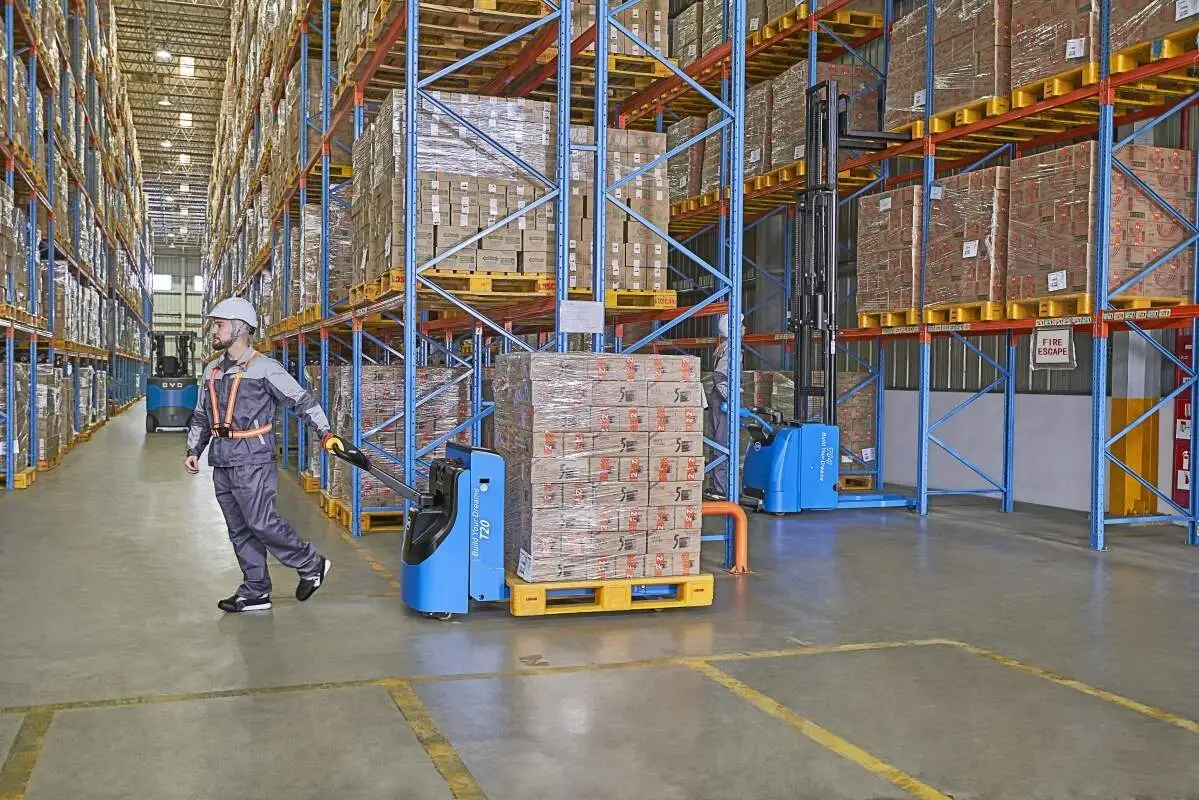
In warehousing operations, forklift truck selection and channel planning directly affect the utilization rate and operation efficiency of the reservoir area. As one of the most widely used load vehicles in domestic warehousing scenarios, the turning radius and corresponding channel width requirements are clarified, which is the core reference item for early selection and reservoir area planning.
The Core Influencing Factors of Turning Radius of 3-ton Forklift Truck
Drive mode difference
Common 3-ton forklifts are divided into different categories such as counterweight type and forward-moving type. The tail of the counterweight forklift needs to be equipped with a counterweight block to balance the front load, and the turning radius is generally larger; the forward forklift counterweight structure is more compact, and the fork can be moved back and forth to adjust the center of gravity. Under the same load conditions, the turning radius is relatively small, which is suitable for narrow channel operation scenarios.
Load and tire condition
There is a certain difference in the turning radius of the vehicle under no-load and full-load conditions. When the overall weight of the vehicle increases at full load, the change of steering torque will cause the actual turning radius to be slightly higher than the no-load parameters. In addition, the different steering gaps of solid tires and inflatable tires will also have a small impact on the actual turning radius. When selecting models, it is recommended to refer to the official parameters of full-load conditions.
Channel width requirements for 3-ton forklifts in different scenarios
Access without operational requirements
It is only used for one-way traffic of vehicles, and there is no need to dock to access goods. The width of the passage can be as long as there is a safety margin of 30 to 50 centimeters beyond the turning radius of the corresponding model. Generally, the width of the one-way passage of the counterweight 3-ton forklift is recommended to be no less than 3.5 meters, and the width of the passage of the forward-moving 3-ton forklift can be compressed to about 3 meters.
Channel with pallet access operation
It is necessary to dock the working channel where the pallet is picked up and placed on the shelf. In addition to the safety margin reserved for the turning radius, the width of the pallet and the clearance of the pick-up and release operation should be increased. The channel width of the counterbalanced 3-ton forklift operation is recommended to be no less than 4.5 meters. When the forward-moving 3-ton forklift is used with the double-sided shelf operation, the channel width can be controlled between 3.5 meters and 4 meters.
Precautions for storage selection
Combining the actual situation of the reservoir area to match the parameters
If it is a new storage area, the appropriate 3-ton forklift model can be selected according to the expected storage capacity utilization rate, and the channel width can be compressed through the narrow channel model to improve the storage space utilization rate. If it is an existing storage area renovation, the actual width of the existing channel should be measured first, and then the corresponding turning radius should be matched to avoid the problem of impassable vehicles.
Reserve sufficient safety margin
The width of the working channel should not be completely stuck with the theoretical minimum setting, and redundant space should be reserved for personnel to walk and temporarily stack goods to avoid safety hazards such as scratching shelves and colliding with goods during operation, and reduce operation losses.