
 简体中文
简体中文 Deutsch
 日本語
日本語 한국어
한국어 Tiếng Việt
 Русский
 ไทย
ไทย Bahasa Indonesia
 Bahasa Melayu
 Filipino
 لالعربية
 Français
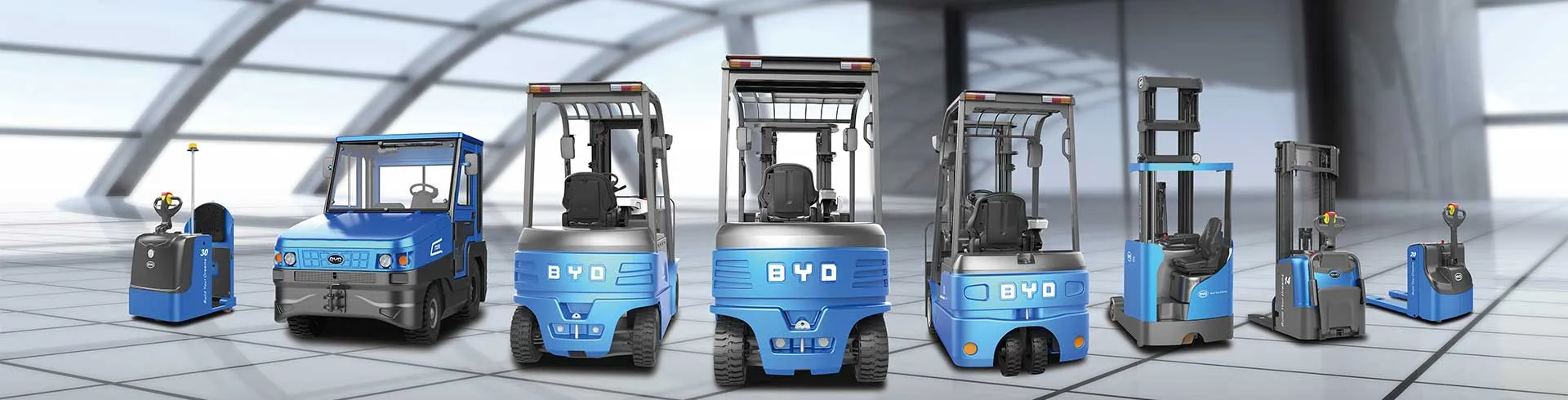
SLAM navigation is the core technology of AGV to achieve autonomous operation, and the adaptation effect of its sensors directly affects the navigation accuracy, operation stability and operation efficiency of the vehicle. For the adaptation of SLAM navigation sensors for BYD AGV models, it is necessary to combine the model structure, operation scenarios and functional requirements to clarify the key parameter standards to ensure efficient coordination between the sensors and the vehicle control system.
Lidar is the core sensing component of SLAM navigation, and the adaptation parameters need to focus on the installation and performance dimensions. The installation height needs to match the body structure of BYD AGV, usually set at a position of 0.3-0 meters above the ground, which not only avoids ground debris blocking the scanning field of view, but also covers the key detection area around the vehicle. The detection angle needs to be selected according to the operation scene. It is recommended to use 360-degree omnidirectional scanning for closed scenes such as indoor warehousing, while the narrow channel scene can be optimized to 180-degree directional scanning to reduce the invalid data occupation of system resources. The detection radius needs to be combined with the operating speed and operating range of the AGV. It is generally recommended to set it to 10-20 meters to meet the needs of real-time obstacle avoidance and path planning. At the same time, the scanning frequency needs to match the response speed of the vehicle control system and be kept in the 10-20 Hz range to avoid data transmission delays affecting navigation decisions.
The adaptation of visual sensors needs to focus on the installation position and image acquisition parameters. The camera should be installed on the top or front of the BYD AGV body in an unobstructed area to ensure that the field of view covers the direction of vehicle travel and the surrounding environment. The lens focal length needs to be adjusted according to the needs of the operation. A short focal length lens is selected for high-speed transfer scenes to broaden the field of view, and a long focal length lens is selected for low-speed fine operation scenes to improve the accuracy of image details. The image acquisition frame rate needs to be synchronized with the computing power of the navigation algorithm, usually kept at 20-30 frames/second, which can ensure the real-time performance of image data without excessive consumption of system computing power.
Communication and interface adaptation are also key links. SLAM navigation sensors need to support the common communication protocol of BYD AGV control system to ensure the compatibility of data transmission. The data transmission rate needs to reach more than 100Mbps to meet the transmission requirements of real-time navigation data. The interface type needs to be exactly matched with the reserved interface of the model to avoid the compatibility risk caused by additional modifications. At the same time, the interface needs to be protected to reduce the interference of dust and water vapor on data transmission.
In addition, the environmental adaptation parameters cannot be ignored. For different operating scenarios, the sensor needs to have the corresponding protection level, such as wet storage environment needs to meet the dust and waterproof standards above IP65, and low temperature operating scenarios need to support the operating temperature range of -10 ° C to 50 ° C to ensure that the sensor can still operate stably in complex environments.
Overall, the adaptation of SLAM navigation sensors to BYD AGV models requires accurate matching of multi-dimensional parameters such as installation, performance, communication, and environment. After actual scenario testing and verification, the advantages of SLAM navigation technology can be fully realized to ensure the efficient and stable operation of AGVs.


