
 简体中文
简体中文 Deutsch
 日本語
日本語 한국어
한국어 Tiếng Việt
 Русский
 ไทย
ไทย Bahasa Indonesia
 Bahasa Melayu
 Filipino
 لالعربية
 Français

The purchase of a 3-ton lithium battery forklift needs to integrate the core parameters and mainstream configuration, and make a reasonable choice in combination with the actual operation scenario. The core parameters are the basis for judging the performance of the forklift, which directly affects the operation efficiency and safety. The first is the rated lifting weight and the load center distance. The rated lifting weight is clearly 3000kg. This is the maximum standard for the safe bearing of the forklift. It is necessary to ensure that the weight of the goods does not exceed this value. The load center distance is usually 500mm, that is, the distance from the center of gravity of the goods to the vertical section of the fork. If the center of gravity of the goods is offset, it may lead to the risk of overturning. When choosing, pay attention to the way the goods
Battery life and battery parameters are the key indicators of a lithium-ion forklift. Battery capacity is expressed in terms of voltage and ampere-hour (Ah). Common 3-ton lithium-ion forklift batteries are mostly 48V or 80V systems with a capacity range of 100Ah-200Ah. Battery life needs to be calculated in combination with working conditions: when fully loaded, the 48V 150Ah battery can support 6-8 hours of continuous operation; lithium iron phosphate battery has a long cycle life (more than 2000 times), suitable for multi-shift operation; ternary lithium battery has high energy density and fast charging speed, suitable for short-distance and high-frequency operation. Charging time varies depending on battery type. Fast charging takes about 1-2 hours to fully charge 80%, and slow charging takes 6-8 hours. It needs to be selected according to the operation rhythm.
Lifting performance parameters affect the adaptation of the operation scene. The maximum lifting height determines the adaptation capacity of the shelf. Indoor warehouses are commonly 3-6 meters, and outdoor or high-level shelves can be selected for more than 7 meters. The lifting speed is about 0.3-0 meters/minute, and the speed and stability need to be balanced. The hydraulic buffer system during the descent process can avoid heavy objects falling. Among the working environment adaptation parameters, the self-weight affects the ground load. The self-weight of the 3-ton lithium electric forklift is about 2.5-3 tons. It is necessary to ensure that the ground can bear the weight. The external dimensions are related to the width of the channel. The smaller the turning radius, the more suitable it is for narrow channels. In terms of ground adaptability, solid tires are suitable for rough ground, pneumatic tires are suitable for flat road surfaces, and low temperature environments need to choose a battery system that supports
Mainstream configuration directly affects the forklift performance and reliability. In the battery system, the lithium iron phosphate battery has high safety and stable low temperature performance. The ternary lithium battery has high energy density. The BMS battery management system can monitor the status to avoid overcharging and overdischarging. In terms of power system, the AC asynchronous motor has high efficiency (more than 90%) and is suitable for heavy-duty high-frequency operations; the DC motor is simple to maintain and suitable for short-distance low-load scenarios. The motor power is usually 3-5kW, and more than 10% of the margin needs to be reserved to deal with full-load climbing.
The configuration of the gantry and the fork determines the stability of the goods. The number of gantry stages is divided into two and three levels. The three-level gantry lifts higher (more than 6 meters) and is suitable for high-level shelves. The gantry material is high-strength steel with a thickness of ≥3mm. The specifications of the fork need to match the size of the goods. The standard fork length is 1220mm and the width is 50mm. The fork spacing can be customized to avoid the goods from slipping. In the safety configuration, the hydraulic steering saves effort and the electric steering is accurate. The dual design of electromagnetic braking and hydraulic braking ensures fast parking. The reversing radar and sound and light alarm can avoid collisions.
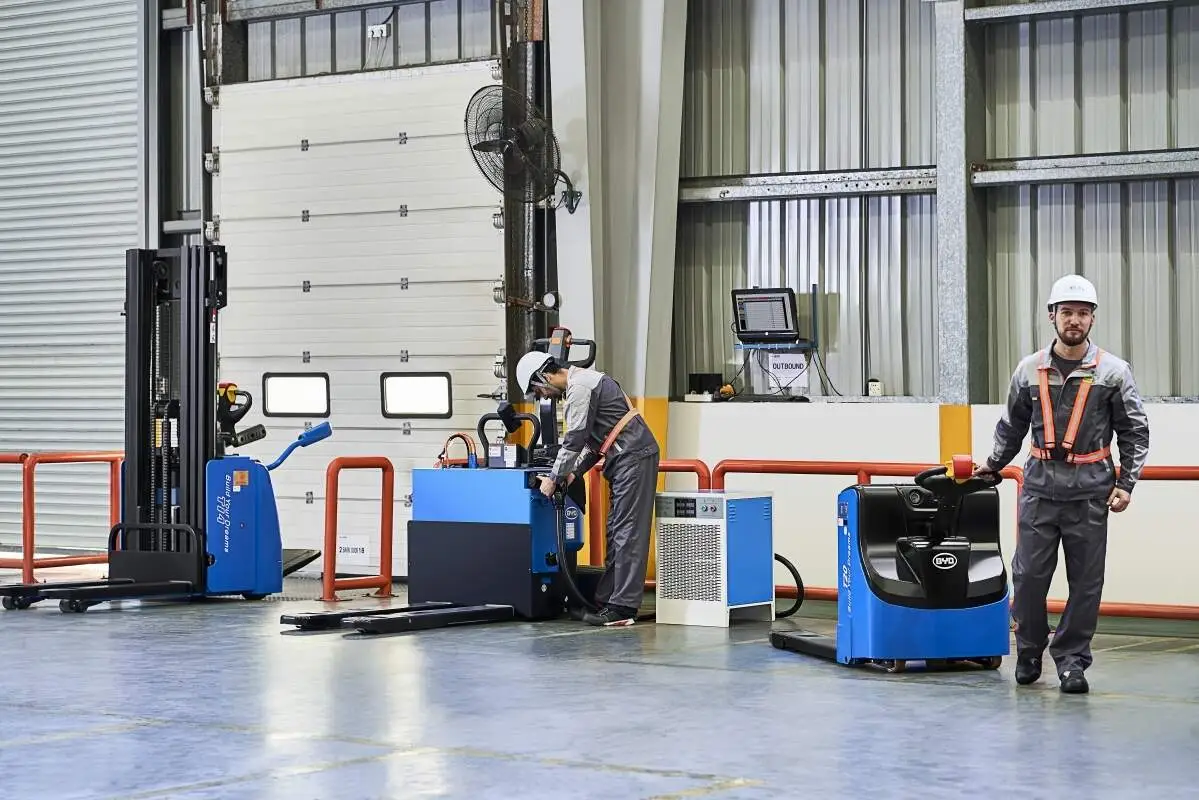
The purchase decision needs to be combined with the scene: the forklift with small steering radius and light weight should be selected for indoor short-distance handling; the solid tire and anti-skid design should be preferred for outdoor construction work. The configuration with long battery life (≥8 hours) and fast charging should be selected for high-frequency operation; the adjustable forks or attachments should be considered for handling special-shaped goods. When the budget is limited, the core performance (battery, motor) should be met first, and the number of gantry stages should be reduced but the lifting height should be guaranteed. In terms of comprehensive cost, the lithium-ion forklift is easy to maintain. The annual maintenance fee is only 1/3 of the fuel forklift. The battery life is 5-8 years. The second-hand residual value is high, and the long-term use is more economical. It is necessary to confirm whether the battery supports replacement When purchasing, it is necessary to balance performance and budget to ensure that parameters and configurations are suitable for actual operation requirements, and to avoid affecting efficiency due to insufficient parameters or increasing costs due to configuration redundancy.


