
 简体中文
简体中文 Deutsch
 日本語
日本語 한국어
한국어 Tiếng Việt
 Русский
 ไทย
ไทย Bahasa Indonesia
 Bahasa Melayu
 Filipino
 لالعربية
 Français

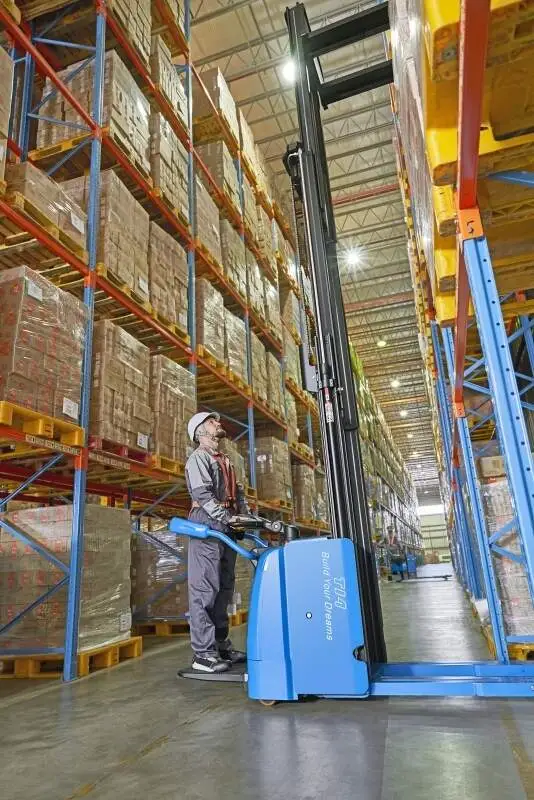
The three-pivot counterweight electric forklift is widely used in warehousing, logistics, small factories and other scenarios due to its compact structure and flexible steering. As one of these products, BYD CPD16S needs to be purchased according to specific operational requirements, performance parameters and scene adaptability.
First, clarify the job requirements and scenario characteristics
Before purchasing, it is necessary to determine the core requirements of the operation. In terms of working space, if the shelf spacing is small and the passage is narrow in the storage environment, the characteristics of the three-point balance forklift with small turning radius and high flexibility can effectively improve the traffic efficiency, which is suitable for such scenarios; if the working area is open, the matching degree of lifting height and driving speed can be properly paid attention to. In terms of cargo characteristics, it is necessary to confirm the actual weight (within the rated lifting weight range of 1.6 tons) and size (such as whether the length, width and height are suitable for standard forks) to avoid affecting the safety and efficiency of the operation due to overload or size discrepancy. Operating frequency and duration also need to be considered. High-frequency and long-term operations require priority attention to battery life, and choose a large-capacity battery or a model that supports fast charging to ensure that a single battery life meets the operating cycle. Intermittent operations can balance battery life and charging time, avoiding waste of resources.
Second, focus on core performance parameters
Power and endurance are the core indicators of electric forklifts. It is necessary to know the motor power, battery type (such as lead-acid battery or lithium battery) and capacity, and whether the actual cruising mileage (full load/no load state) meets the operation needs. Whether the charging time matches the use arrangement, such as whether the night charging can support the next day's all-day operation. Steering and operating performance directly affect the operation efficiency. The steering angle and minimum turning radius of the three-pivot design must meet the requirements of narrow passages. The comfort of the operating handle and the control accuracy (such as micro-motion control) also affect the operation fluency. In terms of lifting and lowering performance, the lifting height needs to meet the needs of the shelf to pick and place, the lifting speed and descent smoothness (to avoid cargo shaking) need to be paid attention to, and the load-bearing capacity of the fork needs to match the rated lifting capacity.
III. Assessment in combination with specific operating scenarios
In indoor operation scenarios, the advantages of electric forklifts with no exhaust emissions and low noise make them the best choice for clean environments, such as food processing, pharmaceutical warehouses, etc. It is necessary to confirm whether the battery type meets environmental protection standards. If you need to carry it outdoors for short distances, you need to pay attention to the waterproof level and dustproof ability of the battery to avoid humid or dusty environments affecting the life of the equipment. In special environments such as low temperature and high temperature scenarios, you need to choose suitable batteries and motors to ensure stable operation of the equipment under extreme conditions.
IV. Emphasize security configuration and operation experience
Safety configuration is an important consideration when purchasing. Car body stability design (center of gravity control with three-point structure), braking system reliability (electromagnetic braking or hydraulic braking), reversing warning devices (such as buzzer, sound and light alarm) and ease of use of emergency stop buttons all need to meet safety operation requirements. In terms of operation experience, driver's seat adjustment function, operation handle force feedback, instrument panel information clarity (such as power, fault prompt) and shock absorption design can reduce the fatigue of long-term operation and improve operation efficiency.
V. Consider long-term use costs and service support
Maintenance convenience directly affects the cost of use, whether the battery supports quick replacement, whether the daily checkpoint is easy to operate, and whether the supply of wearing parts is sufficient, all need to be taken into account. After-sales services Network coverage, response speed (such as door-to-door time for failure repairs), regular maintenance services and operation training support can ensure long-term stable operation of the equipment and reduce the risk of use.
When purchasing a BYD CPD16S three-point counterweight electric forklift, it is necessary to comprehensively evaluate the operation requirements, performance parameters, scene adaptability, safety configuration and long-term maintenance costs, and choose the appropriate model based on its own usage habits to ensure the efficient completion of warehousing and logistics operations.


