
 简体中文
简体中文 Deutsch
 日本語
日本語 한국어
한국어 Tiếng Việt
 Русский
 ไทย
ไทย Bahasa Indonesia
 Bahasa Melayu
 Filipino
 لالعربية
 Français

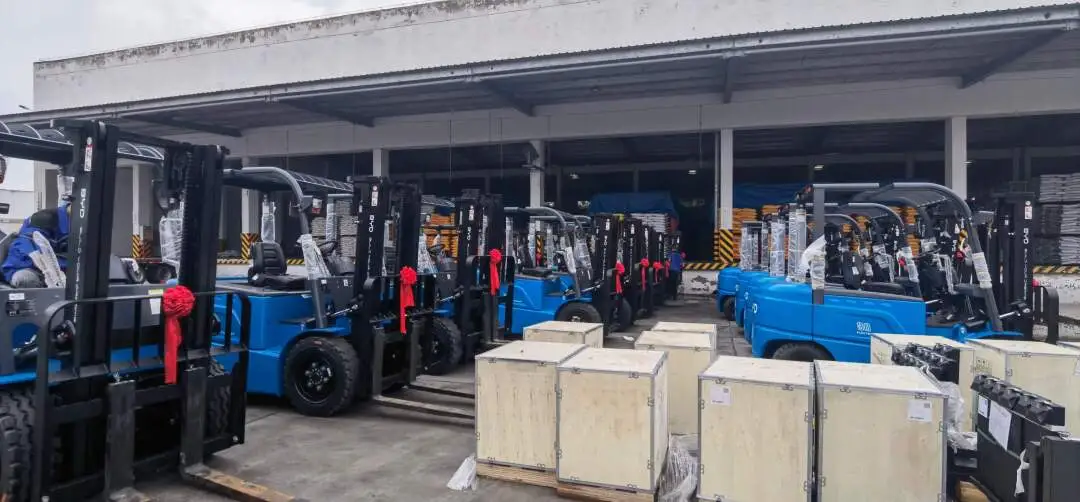
The daily operation of the building materials factory revolves around the handling of heavy objects such as sand and gravel, plates, and cement. The operation scenarios cover a variety of environments such as open storage yards and closed warehouses. The road conditions are complex and there is a lot of dust, which has high requirements on the bearing capacity, traffic flexibility, endurance and protection performance of forklifts. 5 tons is the main handling tonnage of the building materials factory. When selecting the type, it is necessary to closely match the scene characteristics to ensure the efficient and stable operation.
Analysis of Core Requirements of Building Materials Factory Operation Scenario
Heavy-duty handling requirements: The weight of sand, gravel, prefabricated parts and other goods handled by a building materials factory is mostly concentrated in the range of 3 to 5 tons, and the weight of some heavy-duty plates is close to 5 tons. Forklifts are required to have a stable full-load bearing capacity to avoid problems such as body tilt and fork deformation.
Complex site traffic requirements: The passage in the warehouse is narrow, requiring forklifts to steer flexibly; the open-air yard road surface often has potholes and gravel, requiring forklifts to have good passability and reduce the risk of chassis collisions.
Battery life and energy consumption requirements: Building materials factories operate for 8 to 10 hours a day, and forklifts need to meet the battery life requirements of continuous operation. At the same time, energy consumption needs to be controlled reasonably to reduce long-term operating costs.
Dust protection requirements: A large amount of dust will be generated during sand and gravel loading and unloading and cement handling. If the protection of key components of the forklift is not in place, it is easy to cause failure and shorten the service life of the equipment.
Description of Scene Adaptability of CPD50 Electric Forklift
Heavy-duty load-bearing adaptation: The CPD50 has a rated load-bearing capacity of 5 tons, and the body body is made of high-strength steel. The fork structure has been strengthened to maintain the overall stability of the body when handling full-load building materials, effectively avoiding the shaking of the goods or the tilting of the body. It is suitable for the handling needs of various heavy building materials.
Complex site traffic adaptation: The forklift adopts a small turning radius design, which can easily complete steering and U-turn operations in the narrow passage of the warehouse; the chassis ground clearance is set reasonably, which can adapt to the potholed road surface of the open field, reduce the collision between the chassis and the ground obstacles, and take into account indoor and outdoor operation scenarios.
Battery life and energy consumption adaptation: Equipped with a large-capacity power battery, the battery life can cover the continuous operation needs of the building materials factory in a single day; at the same time, it is equipped with a high-efficiency power system, which can reasonably control energy consumption and reduce energy expenditure in daily operations.
Dust protection adaptation: The vehicle adopts a sealed design, and key components such as motors and controllers are equipped with dust-proof devices, which can effectively reduce dust intrusion, reduce the probability of equipment failure caused by dust, prolong the service life of the equipment, and adapt to the dusty operating environment of the building materials factory.
Overall, the CPD50 electric forklift can match the core operating requirements of building materials factories in terms of carrying capacity, traffic flexibility, battery life performance, and dust protection, making it a reliable option for the selection of 5-ton forklifts in building materials factories.


