
 简体中文
简体中文 Deutsch
 日本語
日本語 한국어
한국어 Tiếng Việt
 Русский
 ไทย
ไทย Bahasa Indonesia
 Bahasa Melayu
 Filipino
 لالعربية
 Français

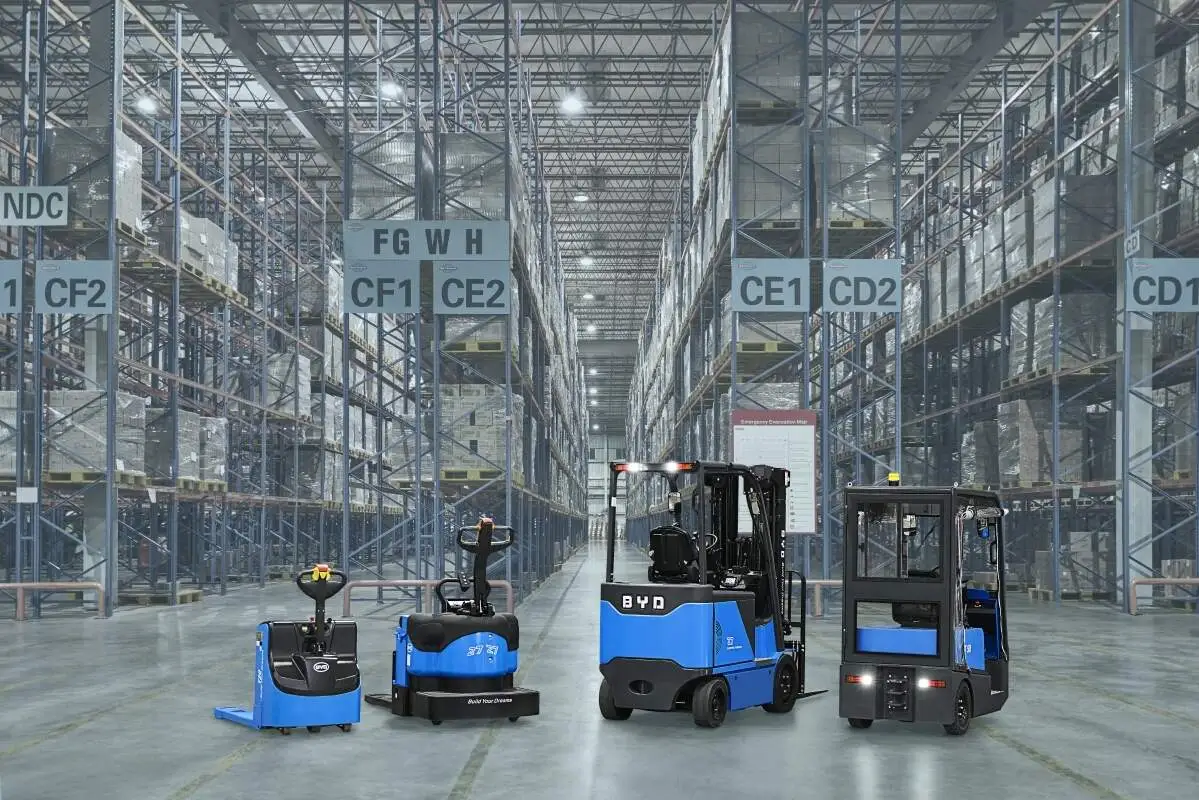
As the core hub of the cross-border flow of goods, the cross-border comprehensive warranty area has high turnover frequency of goods and complex operation scenarios, which has strict requirements on the compliance and safety of handling equipment. With its flexible steering performance and moderate carrying capacity, the 1-2.5-ton three-point electric forklift has become a common equipment for short-distance cargo handling within the comprehensive warranty area, and the configuration in line with CE standards is the key to adapting it to cross-border operation scenarios.
The first is the safety protection CE configuration. According to the relevant European Union standards, forklifts need to be equipped with multiple safety protection devices: the emergency stop button can quickly cut off the power system of the equipment in an emergency to avoid the expansion of the accident; the seat safety switch ensures that only when the operator is seated normally and locks the seat, the equipment can be started, effectively preventing safety risks caused by misoperation; in addition, the anti-dumping device and the fork safety lock are also necessary configurations. The former provides stability support when the forklift lifts the goods or turns, and the latter can fix the fork position to avoid the goods slipping.
The CE standard has clear requirements on the insulation performance and electromagnetic compatibility of electrical equipment. 1-2.5-ton three-point forklifts need to use insulating components that meet European Union standards to prevent the risk of electrical leakage. At the same time, they are equipped with overload protection devices. When the equipment load exceeds the rated range, the power will be automatically cut off to protect the motor and circuit. The battery management system needs to have overcharge and overdischarge protection functions, which not only prolong the service life of the battery, but also avoid safety hazards caused by electrical failures. And the entire electrical system needs to pass the electromagnetic compatibility test to ensure that the operation will not interfere with the surrounding electronic equipment.
Another is the control and field of view configuration. In order to meet the ergonomic requirements of CE, the forklift needs to use an ergonomically designed control handle, which fits the operator's hand force habits and reduces the fatigue of long-term operation; the panoramic field of view design optimizes the operator's field of view and reduces the risk of collision caused by blind spots; some configurations also include a speed limit function, which can automatically limit the driving speed when working in narrow passages to improve work safety.
Finally, the logo and document configuration. The forklift body needs to be clearly marked with the CE logo to facilitate cross-border inspection; at the same time, it needs to be equipped with a multi-language version of the operation manual and maintenance manual, including at least English, to meet the needs of operators in different regions; in addition, the equipment needs to be accompanied by a compliance CE test report, as an official certificate of equipment compliance with European Union standards, to ensure compliance when operating in cross-border comprehensive insurance areas.
These CE configurations are not only an entry requirement for equipment-related markets, but also enhance the safety and reliability of cross-border comprehensive warranty area operations, helping enterprises to efficiently complete the task of cargo handling and circulation.


