简体中文
简体中文 Deutsch
 日本語
日本語 한국어
한국어 Tiếng Việt
 Русский
 ไทย
ไทย Bahasa Indonesia
 Bahasa Melayu
 Filipino
 لالعربية
 Français
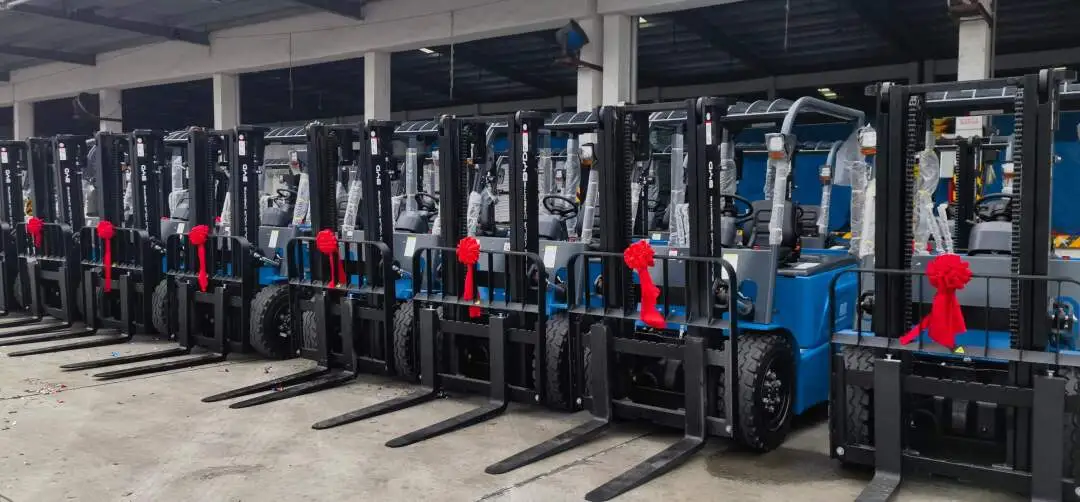
3-Ton forklifts are commonly used handling equipment in warehousing, logistics, manufacturing, cargo distribution and other scenarios. With different functional attachments, they can greatly expand the applicable scenarios and meet diverse operation needs. Many users do not know how to combine attachments with their own operation needs. The following are the corresponding configuration plans for different situations.
Attachment Matching for Conventional Handling Scenes
Whole tray cargo transfer scenario. If the daily operation is mainly based on standard pallet loading and unloading and short-distance transshipment of whole tray goods, no additional special attachments are required, only standard forks with matching loads can be selected. Some users who need to adapt to non-standard size pallets can choose forks with adjustable spacing and flexibly adjust the fork distance to adapt to pallets of different specifications. This type of configuration has low cost and low maintenance difficulty, and is suitable for most general warehousing and logistics loading and unloading scenarios.
Scattered goods stacking scene. If the operation involves high-level stacking of scattered cartons and woven bags, in addition to the basic fork, anti-skid fork sleeves can be installed to increase the friction between the fork and the bottom of the goods, avoid the goods from slipping, and improve the safety of the stacking operation. Side shifters can also be installed to facilitate the adjustment of the fork position in narrow passages, eliminating the need to move the forklift body frequently, effectively improving operation efficiency and reducing channel space occupation.
Attachment matching for special categories of goods
Soft package or cylindrical cargo handling scene. If you need to carry cylindrical goods such as paper rolls, fabric rolls, pipes, or flexible packaging goods such as fertilizer bags and cement bags, you can choose a holding device, and choose the corresponding holding force according to the material, size and weight of the goods to avoid damage to the goods. Some holding clips with rotating function can also meet the needs of goods turning over and dumping, and adapt to more special operation requirements.
Long-strip cargo handling scenarios. If you need to handle long-strip goods with a length of more than 2 meters such as steel, plates, and ultra-long pipes, you can choose to lengthen the fork or ejector. For some scenarios that require side loading and unloading, a rotating fork can also be installed to facilitate adjusting the angle of the goods in a confined space, reducing the difficulty of the operation and reducing the risk of scratches.
Attachment matching for special working conditions
High-humidity or low-temperature operation scenarios. If the forklift is mainly operated in cold chain warehouses, fresh processing workshops, and coastal high-humidity areas, the attachment tool should be made of rust-proof and low-temperature resistant materials to avoid long-term rust and brittle cracking in special environments. Users in need can also install a fork heating device to avoid freezing the goods with the fork in a low-temperature environment, which will affect the loading and unloading efficiency.
Dangerous goods handling scenarios. If you need to handle flammable, explosive, and corrosive dangerous goods, you should choose a style with anti-static and anti-corrosion characteristics, and you can install a cargo stabilizer to avoid safety accidents caused by goods falling or leaking during transportation.
Finally, users should be reminded that when selecting attachments, they should confirm in advance whether the load of the attachments matches the rated load of the 3-ton forklift. After installing attachments, they should re-evaluate the actual bearing capacity of the forklift to avoid overloading operations. At the same time, they should choose regular products that meet safety standards, regularly check and maintain the attachments, and promptly check for problems such as looseness and wear to ensure operation safety.