简体中文
简体中文 Deutsch
 日本語
日本語 한국어
한국어 Tiếng Việt
 Русский
 ไทย
ไทย Bahasa Indonesia
 Bahasa Melayu
 Filipino
 لالعربية
 Français
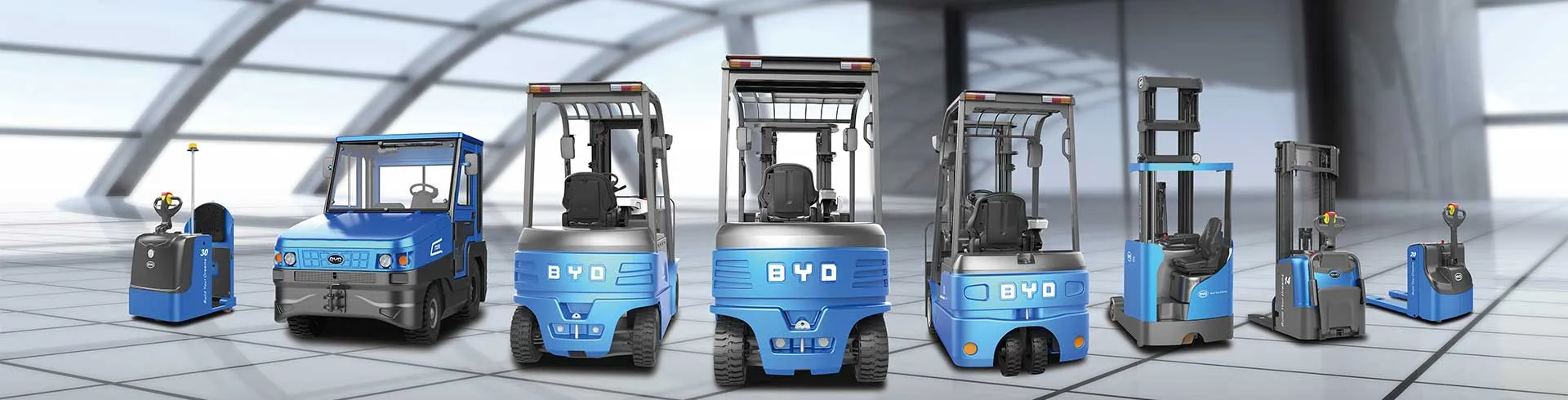
.webp "The technical characteristics and development trend of new energy forklifts(Image1)")
With the acceleration of the green transformation process in the warehousing and logistics industry, new energy forklifts have gradually become the mainstream choice of material handling equipment in the field, and the speed of relevant technology iteration and application has also continued to increase.
The first is the core technical features of new energy forklifts.
Continuous optimization of power adaptability. The current mainstream new energy forklifts mostly use clean power sources. Compared with traditional internal combustion forklifts, the start-up response speed is faster, the power output is stable and controllable, and it can adapt to the material handling needs of different weight classes. The adaptation technology for special operating scenarios such as low temperature and high humidity is also gradually improving, which can meet the requirements of multiple scenarios such as cold chain storage and outdoor short-distance transshipment.
The energy consumption control performance is outstanding. The energy conversion efficiency of new energy forklifts is much higher than that of traditional internal combustion forklifts. Most models are equipped with kinetic energy recovery systems, which can recover part of the kinetic energy during braking and downhill, further reducing operating energy consumption. At the same time, the vehicle has no idling loss, and the energy-saving advantages in intermittent operation scenarios are more obvious, which can effectively reduce the user's cost of use.
The advantages of operation and maintenance and environmental protection are significant. The new energy forklift does not have the complex structure of the internal combustion system. The daily maintenance only needs to check the circuit, power unit and other core components. The DevOps flow is simple and the comprehensive cost is lower. There is no exhaust emission during operation, and the operation noise is small, which can meet the use standards of food processing, medical warehousing and other scenes with high environmental hygiene requirements.
Secondly, the future development trend of new energy forklifts.
The degree of intelligent integration continues to deepen. In the future, new energy forklifts will gradually integrate functions such as automatic navigation, obstacle recognition, and cluster scheduling to adapt to the operational needs of unmanned warehousing. They can also be connected to logistics management systems to achieve real-time upload and analysis of operational data, helping to improve the efficiency of warehousing operations.
The trend of scene customization is obvious. In response to the differentiated needs of different industries, more subdivided and adapted models will be launched in the future, such as explosion-proof models suitable for chemical warehousing, large-tonnage models suitable for port terminals, etc., to further expand the coverage of new energy forklifts.
The supporting service system is gradually improved. In the future, the layout of supporting facilities such as charging and power exchange will be more popular, and the operation mode such as battery leasing and equipment sharing will gradually mature, lowering the threshold for users to use, and promoting the market penetration rate of new energy forklifts to continue to increase.