简体中文
简体中文 Deutsch
 日本語
日本語 한국어
한국어 Tiếng Việt
 Русский
 ไทย
ไทย Bahasa Indonesia
 Bahasa Melayu
 Filipino
 لالعربية
 Français

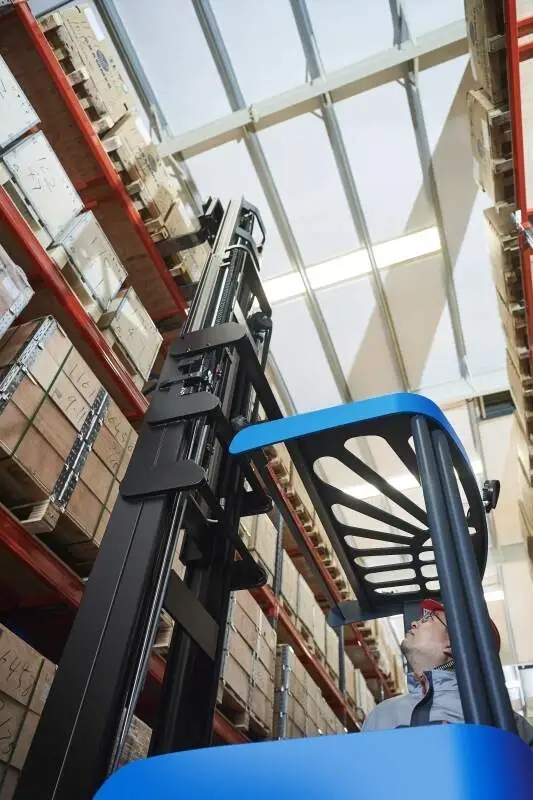
Cold storage is always in a low temperature and high humidity environment. When electric forklifts enter and exit the storage area, the temperature difference between the inside and outside can easily lead to condensation on the surface and internal components of the equipment. Without targeted design protection, it is easy to cause equipment failure, affecting the safety and efficiency of the operation.
Operational hidden dangers brought by condensate to cold storage forklifts
Circuit system failure risk
After condensation water seeps into the circuit interface and control module, it is easy to cause circuit short circuit and component rust, which can lead to functional failure at best, and may cause safety hazards such as leakage at worst, greatly shortening the service life of electronic components and increasing equipment maintenance costs.
Accelerated wear and tear of mechanical components
Condensate adheres to the surface of bearings, chains, lifting rails and other metal components, causing long-term accumulation of rust, increasing friction resistance between components, accelerating wear and tear, and increasing equipment maintenance costs. In severe cases, it may also lead to parts getting stuck during operation, causing safety accidents.
Structural Design Ideas of Cold Storage Electric Forklift to Deal with Condensate Water
Full scene sealing structure optimization
For circuit modules and motor areas that are prone to water ingress, a high-level sealing structure design is adopted to fill the wiring ports and module splicing gaps with sealant and install sealing gaskets to reduce the probability of condensation infiltrating internal components from the source, while taking into account heat dissipation requirements to avoid the problem of high operating temperature of equipment caused by sealing.
Corrosion and moisture resistant material selection
The shell and components with high frequency of contact with condensate are preferentially made of anti-rust and corrosion-resistant materials, the surface of metal parts is treated with special anti-rust coatings, and the insulating components are made of materials with stronger moisture resistance to reduce the risk of rust and aging caused by condensate adhesion.
Directional drainage path design
In the equipment, there are preset diversion grooves and drainage holes with reasonable slope, even if a small amount of condensate water infiltrates, it can be discharged out of the equipment along the preset path to avoid accumulation in the internal key components and reduce the soaking damage of the components caused by water accumulation.
Convenient maintenance structure reservation
Reserve easy-to-open inspection ports in areas where condensate is easily stored, so that operators can regularly clean up residual water and wipe moisture, reducing the risk of failure caused by long-term accumulation.
Through the above targeted structural design, the negative impact of condensate on cold storage electric forklifts can be greatly reduced, the operating stability of the equipment in low temperature and high humidity scenarios can be improved, the maintenance cost of the whole life cycle can be reduced, and the actual needs of cold storage operations can be better adapted.