
 简体中文
简体中文 Deutsch
 日本語
日本語 한국어
한국어 Tiếng Việt
 Русский
 ไทย
ไทย Bahasa Indonesia
 Bahasa Melayu
 Filipino
 لالعربية
 Français
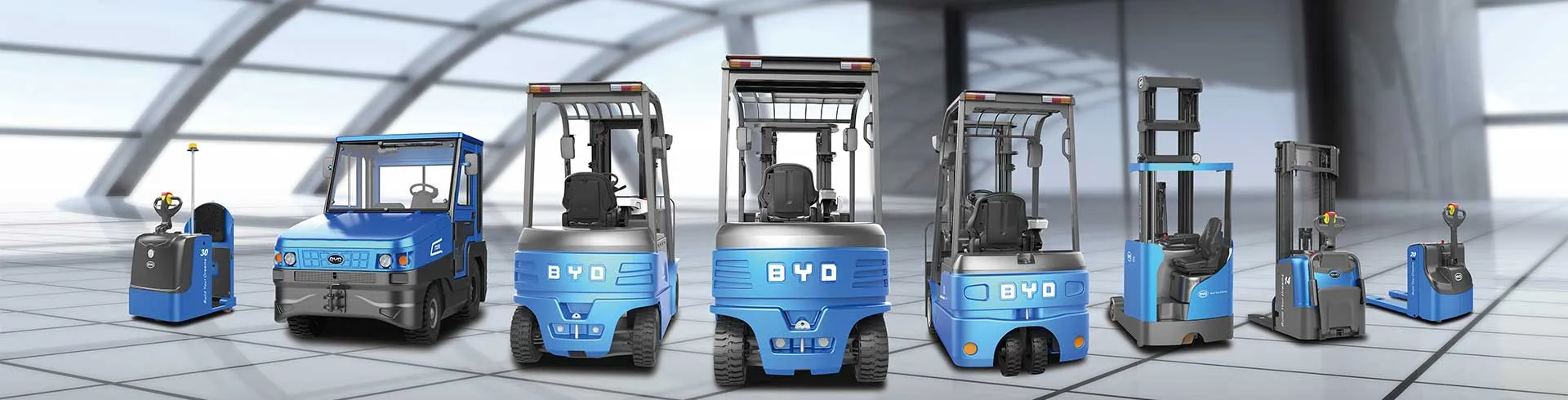
With the acceleration of the green transformation of the logistics industry, BYD's new energy forklift has become the mainstream choice for warehousing and industrial handling due to its advantages of zero emissions and low noise. The technical characteristics of its structural design and operation and maintenance management directly affect the reliability and cost of equipment. This paper analyzes the core design characteristics, operation and maintenance points and key technical advantages of BYD's new energy forklift from a technical perspective.
First, the structural design features of BYD's new energy forklift
#1. Power system architecture optimization
The power system is the core of BYD's new energy forklift, and the use of high-efficiency drive scheme is the key to the design. BYD adopts the integrated design of permanent magnet synchronous motor and controller in the power system integration, and realizes the precise output of torque through vector control algorithm to match the load demand under different working conditions. The rigid connection design of the motor and the transmission system reduces energy loss and improves the power response speed.
#2. Battery system integration innovation
As an energy carrier, the design of the battery directly affects the battery life and safety. BYD adopts a modular battery pack design, combined with high energy density cells, to improve space utilization through rational layout. At the same time, the battery management system (BMS) realizes charge and discharge balance control, real-time monitoring of cell voltage, temperature and other parameters to prevent overcharge and overdischarge, and prolong battery cycle life. Part of the design also considers fast charging interface and thermal management system to balance fast charging efficiency and battery life.
#3. Balancing lightweight and stability

The body structure uses high-strength lightweight materials, such as aluminum alloy frame and composite cover parts, to ensure load-bearing capacity while reducing the weight of the whole machine. The chassis design optimizes the distribution of the center of gravity, and adjusts the front and rear axle structures to match the suspension system to improve the stability under heavy load conditions and reduce tire wear and steering resistance.
Second, BYD's new energy forklift operation and maintenance characteristics
#1. Daily maintenance points
Daily operation and maintenance requires attention to key components such as batteries, motors, and hydraulic systems. Battery maintenance requires regular inspection of the connection terminals and electrolyte status (such as lead-acid batteries). Lithium battery systems need to avoid deep discharge. It is recommended to keep the power in the range of 20% -80%. The motor and controller need to clean the heat sink regularly to prevent dust accumulation from affecting the heat dissipation efficiency. The hydraulic system needs to replace the hydraulic oil on a regular basis to check the aging of the seals.
#2. Fault diagnosis and life management
The intelligent operation and maintenance system collects real-time operation data through sensors to establish a fault warning model. When abnormal battery SOC (state of charge) is detected, motor temperature exceeds the limit or hydraulic pressure fluctuations, the system automatically triggers a prompt to reduce the probability of sudden failure. At the same time, based on the life prediction function of big data analytics, the replacement cycle of wearing parts can be planned in advance, such as steering wheels, contactor touchpoints, etc., to reduce unplanned downtime.
#3. Full life cycle cost control
The operation and maintenance cost advantages of BYD's new energy forklifts are significant. Compared with traditional fuel forklifts, its energy consumption costs are reduced by more than 70%, and the maintenance frequency is lower. The battery system further extends the value cycle through step-by-step utilization technology (such as decommissioned batteries for energy storage). In addition, the intelligent operation and maintenance platform supports remote monitoring, reduces on-site inspection manpower input, and comprehensively reduces the cost of ownership throughout the life cycle.
III. Analysis of key technologies
#1. Efficient energy management technologies
The energy management system integrates energy distribution strategies for charging, discharging, standby and other scenarios, and optimizes energy recovery through intelligent algorithms, such as converting kinetic energy to electrical energy during braking and storing it in the battery system. BYD uses a bidirectional DC/DC converter to improve the energy conversion efficiency to more than 95%, significantly extending the range.
#2. Intelligent operation and maintenance and data application
The integration of Internet of Things technology realizes remote monitoring of equipment and data lake visualization. Operation and maintenance personnel can view equipment operation status, historical fault records and maintenance suggestions through the mobile end APP. The data platform supports multi-device networking management, and identifies potential failure modes through cluster analysis to provide data support for preventive maintenance.
#3. Scene adaptation technology innovation
For different industry scenarios, such as warehouse stacking, outdoor handling, etc., develop customized technical solutions. For example, outdoor operation models are designed with dustproof and waterproof design, and IP65 protection level ensures stable operation in complex environments; narrow-channel models integrate with navigation systems through steering radius optimization to improve space utilization.
The technological development of BYD's new energy forklifts revolves around greening, intelligence, and efficiency. The optimization of structural design and operation and maintenance characteristics directly promotes its application in various fields. In the future, with the continuous progress of battery technology and intelligent control, new energy forklifts will further improve their comprehensive performance and become the core equipment of industrial logistics.


