简体中文
简体中文 Deutsch
 日本語
日本語 한국어
한국어 Tiếng Việt
 Русский
 ไทย
ไทย Bahasa Indonesia
 Bahasa Melayu
 Filipino
 لالعربية
 Français
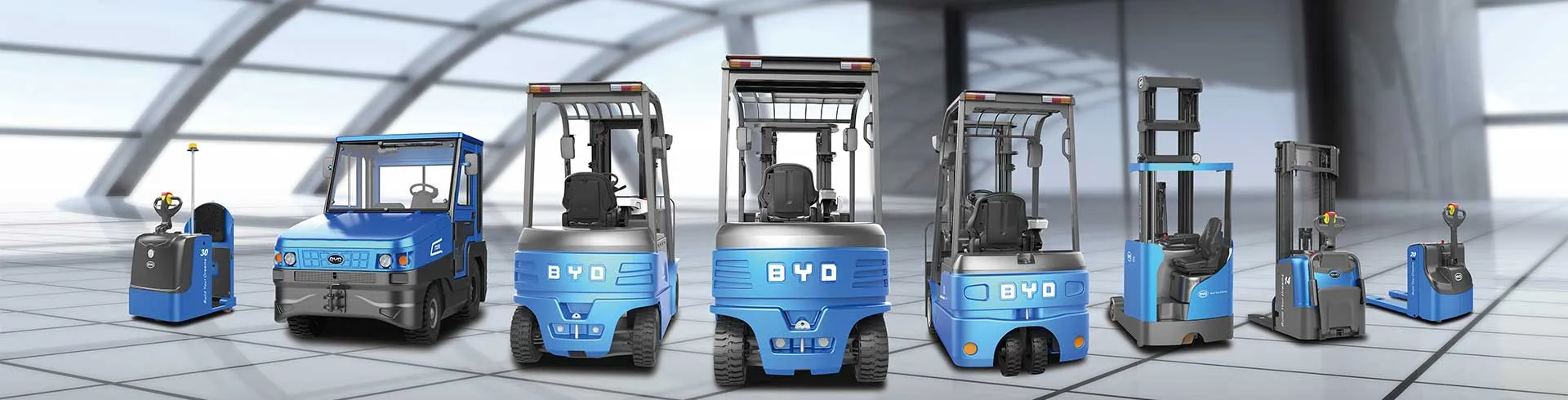
Electric pallet trucks are the core equipment of warehousing and logistics operations. Whether the selection matches the actual demand directly affects the handling efficiency and operating costs. Although BYD's P30PS and P30S pallet trucks are both light handling equipment, there are obvious differences in performance and positioning. The following comparison is made from multiple dimensions to provide reference for selection.
Load and power performance differences
From the perspective of core load capacity and power output, the adaptation scenarios of the two models are different. The P30PS optimizes the power system for continuous heavy-duty operations. When handling goods close to the rated load, the power stability is relatively more prominent, and it can support long-term, high-intensity cargo transfer operations, and the power decay speed is slow. The P30S focuses on lightweight and frequent operations, has a more agile power response, and performs well in energy consumption under low load conditions. It is suitable for short-distance and high-frequency cargo handling needs, which can effectively improve the rhythm of operations.
Application scenario distinction
In terms of the positioning of applicable scenarios, the two have their own focuses. The P30PS is more suitable for scenarios such as large storage centers and manufacturing raw material warehouses. These areas often need to handle heavy pallet goods. The operation path is long and the operation time is long. Its stable power and load performance can better adapt to such needs and reduce the probability of equipment failure. The P30S is more suitable for scenarios such as e-commerce sorting warehouses and small distribution centers. In such scenarios, the weight of goods is relatively light, the operation space is compact, and flexible steering and fast start and stop are required. The flexibility of the P30S can just meet the needs of such operations and improve space utilization.
Control versus comfort
In terms of handling experience, the design details of the two models are different. The layout of the operation panel of the P30PS is more biased towards the needs of heavy-duty operations. The button layout is simple and practical, and the handle grip is relatively heavy. It is suitable for stable operation during long-term operation and reduces hand fatigue. The handle design of the P30S is lighter, with less steering resistance. The operation panel integrates more shortcut functions, and the steering and operation in narrow spaces are more convenient, which can improve the operation efficiency during high-frequency operations. In addition, the shock absorption design of the two models is also different. The shock absorption system of the P30PS is optimized for heavy-duty operation, which can reduce the bumps during heavy-duty driving, while the shock absorption of the P30S focuses more on the comfort during light-duty operation and improves the experience of short-distance operation.
Practical advice for type selection
When selecting a model, an enterprise must first clarify its own job load requirements. If the daily heavy cargo handling is the main one, and the operation time is long, the P30PS will be a more suitable choice. If the operation scene is mostly light cargo, short-distance transshipment, and the operation space is compact, then the flexibility and energy consumption performance of the P30S are more advantageous. At the same time, it is also necessary to comprehensively consider factors such as the operation environment and operation frequency of its own warehouse to ensure that the selected pallet truck can be maximally adapted to the daily operation needs and improve the logistics handling efficiency.