简体中文
简体中文 Deutsch
 日本語
日本語 한국어
한국어 Tiếng Việt
 Русский
 ไทย
ไทย Bahasa Indonesia
 Bahasa Melayu
 Filipino
 لالعربية
 Français

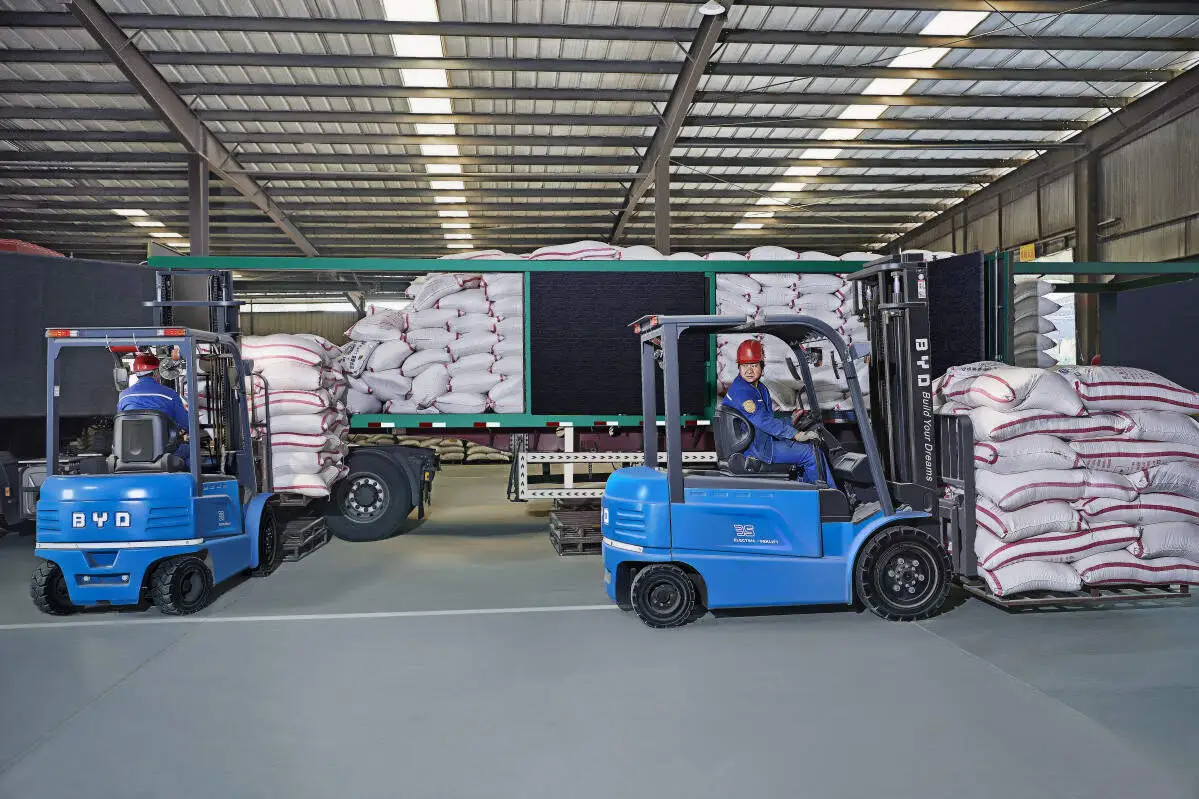
Electric forklifts are commonly used handling equipment in warehousing and logistics. As its core component, the power system directly determines the load capacity, battery life, and operating efficiency of the equipment. Understanding its operating principle is of great significance for daily use and maintenance.
The core components of an electric forklift power system
The power supply module is the foundation of the power system, and the core is the energy storage battery. Currently, commonly used energy storage batteries include lead-acid batteries and lithium iron phosphate batteries, which are responsible for storing the electrical energy required for the operation. The supporting battery management system will monitor the battery voltage, temperature, charge and discharge status in real time to avoid overcharging and overdischarging, ensure power supply stability, and prolong battery life.
The core of the power conversion module is the drive controller, which receives commands such as traveling, lifting, and braking from the operation panel, converts the DC power output from the battery into voltage and frequency adjustable electric energy, and transmits it to the corresponding power unit. At the same time, the output power is adjusted in real time according to the load state to adapt to the needs of different operation scenarios.
The power output module includes a drive motor, a transmission structure, and a hydraulic power unit. After receiving electrical energy, the drive motor converts it into rotating mechanical energy, which is transmitted to the driving wheel through the transmission shaft and gearbox to drive the forklift. The hydraulic power unit drives the oil pump through the motor to operate, converts electrical energy into hydraulic energy, and realizes the lifting, tilting, and other actions of the fork.
Operation Process of Electric Forklift Power System
In the no-load operation state, the forklift is in a scenario where it is traveling flat without cargo, and the controller will actively reduce the output power to reduce unnecessary power consumption. The battery only needs to output a low current to meet the operating requirements, and the hydraulic system is also in a low-load standby state. The overall energy consumption is at a low level.
Under heavy-duty operation conditions, when the forklift needs to carry heavy loads to climb hills or lift heavy goods, after the operation signal is transmitted to the controller, the controller will instantly increase the output power and increase the torque output of the drive motor. The battery management system will also adjust the discharge threshold synchronously to ensure a large current supply in a short period of time, while monitoring the battery temperature in real time to avoid overheating and causing malfunctions.
During the daily maintenance process, it is necessary to regularly check whether the battery terminals are loose and corroded to avoid unstable power supply due to poor contact; after each operation, it is necessary to regulate charging in time, and do not wait for the booster charge after the power is completely exhausted; it is also necessary to regularly clean the controller and the motor's heat dissipation port to avoid dust accumulation and blockage affecting heat dissipation, do not overload the operation for a long time, and avoid the power system being in a high load state for a long time to accelerate the aging of components.