简体中文
简体中文 Deutsch
 日本語
日本語 한국어
한국어 Tiếng Việt
 Русский
 ไทย
ไทย Bahasa Indonesia
 Bahasa Melayu
 Filipino
 لالعربية
 Français

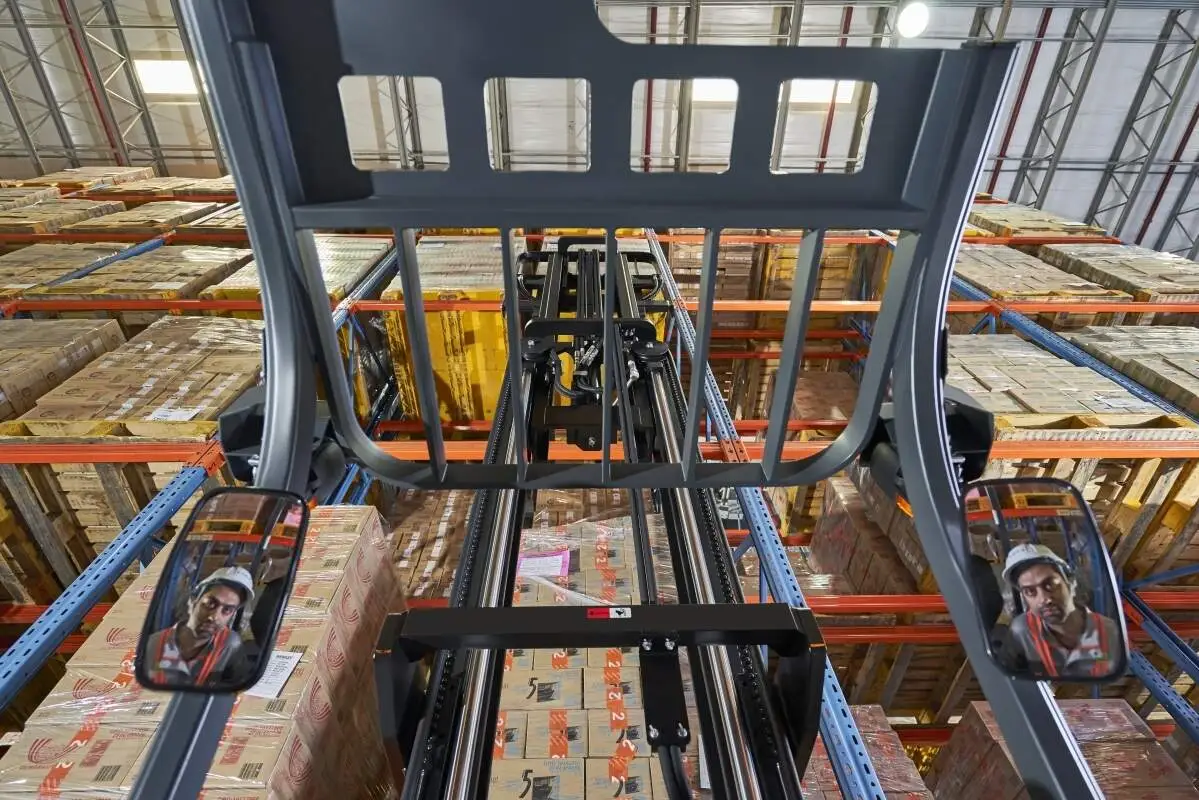
With the popularity of multi-storey warehouses and production workshops, the transfer of goods between floors has become an important part of daily operations, and freight elevators are one of the main transfer tools. However, most standard freight elevators have limited internal space, and the passages in floors are often narrow due to compact layout. Traditional internal combustion forklifts or four-point electric forklifts are often difficult to operate smoothly. At this time, three-point lithium forklifts have become the choice of many users.
The first is the advantage of narrow space adaptation. The design of the three-point structure allows the forklift to have a very small turning radius, and some models also have the function of near-in-place steering, which can complete the U-turn or steering operation in a channel only a little wider than the body, greatly improving the flexibility of picking and placing goods. At the same time, the body size of this type of forklift is usually designed to be relatively compact, and the height and width can be adapted to most common specifications of freight elevators on the market. It can directly enter and exit without additional modifications to the freight elevator, saving the upfront facility investment.
The second is the performance of environmental protection and silence. Traditional internal combustion forklifts generate a large amount of exhaust emissions during operation, which not only does not meet the environmental protection requirements of some cities for production and operation sites, but also cannot enter closed storage or clean workshop areas with high air quality requirements. Although lead-acid forklifts have no exhaust gas, a small amount of acid mist will be released during charging, and long-term use will have a certain impact on peripheral equipment and operators, and the combined noise of machinery and motor during operation is also large. The three-point lithium-ion forklift adopts pure electric drive, with zero emissions throughout the process, and no harmful gases during the charging process. At the same time, the optimized motor operation noise is low, and it can operate normally during most non-rest periods without interfering with the work or storage environment of surrounding personnel.
The third is the convenience of battery life and replenishment. With the mature application of lithium battery technology, the battery life of the three-point lithium forklift has been able to meet the daily floor handling needs of most enterprises, and there is no need to charge or replace the battery frequently. At the same time, most of these forklifts support the fast charging function. Generally, fast charging can replenish half a day's working power in half an hour to an hour. If it is a replacement model, it can also complete the power change and continue the operation in a shorter time, effectively avoiding the interruption of the operation caused by insufficient power and improving the overall work efficiency.
Finally, there is the convenience of comprehensive use cost and maintenance. Internal combustion forklifts need regular refueling, replacement of oil filters and other consumables, and the cost of oil and regular maintenance is high in the long run; lead-acid forklifts need to regularly check the electrolyte level, replenish distilled water, and pay attention to the ventilation and dryness of the charging environment. The maintenance process is cumbersome, and the battery life is relatively short. The three-point lithium forklift basically does not require daily complex maintenance, only needs regular simple inspections of the battery interface and vulnerable parts of the body. The service life of the battery is also much longer than that of the lead-acid battery, and the long-term use cost is lower.