简体中文
简体中文 Deutsch
 日本語
日本語 한국어
한국어 Tiếng Việt
 Русский
 ไทย
ไทย Bahasa Indonesia
 Bahasa Melayu
 Filipino
 لالعربية
 Français

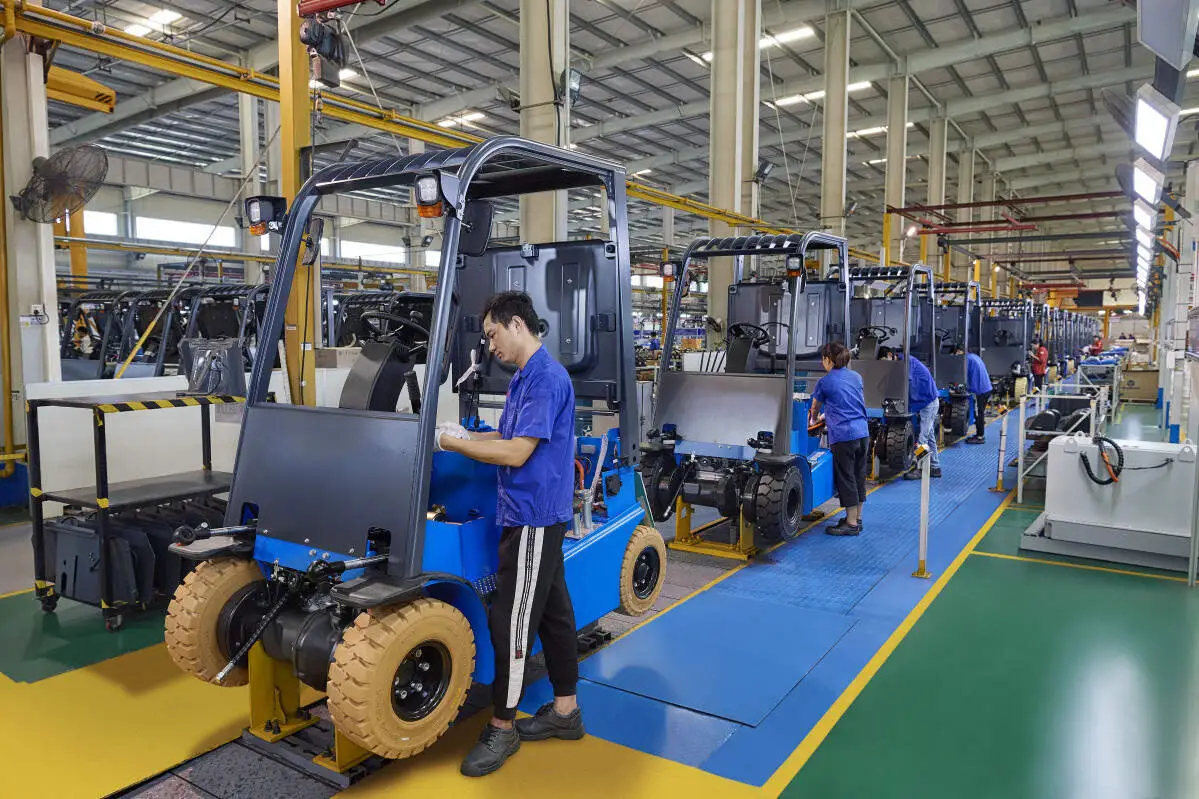
In warehousing logistics and internal material transfer scenarios, the 2-ton electric pallet truck is a key equipment to improve handling efficiency. When selecting a model, it is necessary to match the core characteristics of the model according to the needs of operation frequency and site environment. BYD's P20SII and P20JS two 2-ton electric pallet trucks have differences in many core dimensions. The following is a detailed analysis.
Power system and range performance differences
Battery configuration difference
The two models use different battery technology routes. The battery equipped with the P20SII performs better in the number of cycles charged and discharged, suitable for long-term high-frequency operation scenarios, which can effectively prolong battery life and reduce later maintenance costs. The battery of the P20JS supports faster charging speed, which can restore sufficient power in a short time, and is suitable for scenarios with short operation gaps and quick replenishment.
Battery life comparison
In a conventional operating environment, the P20SII has a longer single battery life, which can cover the needs of long-distance material transfer in large warehouses and reduce the number of midway charges. The P20JS's battery life is more focused on short-distance and high-frequency operations, and a single battery life can meet multiple rounds of sorting and transfer tasks. The fast charging feature further makes up for the limitation of battery life.
Control design and ergonomic differences
Control the layout difference
The operating handle of the P20SII adopts a compact design, with a simple button layout, suitable for working environments with narrow spaces. Operators can quickly complete steering, lifting, and other operations to improve space utilization. The operating handle of the P20JS has a multi-gear adjustment function, allowing operators to adjust the angle according to their own holding habits and adapt to the needs of operators of different heights.
Comfort design comparison
The pedal area of the P20SII fits the conventional working posture, reducing the fatigue of standing for a long time; the P20JS adds a shock absorption buffer structure, which can effectively relieve vibration transmission and improve the comfort of the operator when working on a bumpy ground. It is more suitable for long-term continuous operation scenarios.
Application scenario difference
Conventional warehousing operation adaptation
For long-distance material transfer operations in large warehouses, the long battery life and stability of the P20SII are more advantageous; while in scenarios such as e-commerce sorting centers that require frequent starts and stops, the flexible control and fast charging characteristics of the P20JS can better adapt to the rhythm of operations.
Special working conditions adaptation
In low-temperature environments, the P20SII's battery performance has a small attenuation range, which can stably support outdoor or semi-outdoor operations in northern winter. The P20JS is more suitable for fine-grained operations in indoor room temperature environments, and its flexible control performance enhances sorting and tally efficiency.
Overall, when selecting a model, it is necessary to consider the core requirements of its own operating scenarios. If it focuses on battery life stability and long-term cost, the P20SII can be given priority. If it focuses on fast charging efficiency and handling comfort, the P20JS is a more suitable choice.