2026-07-11

Täglicher Umschlag von grenzüberschreitenden Zolllagern, praktischer Betrieb von kleinen dreirädrigen Elektrostaplern

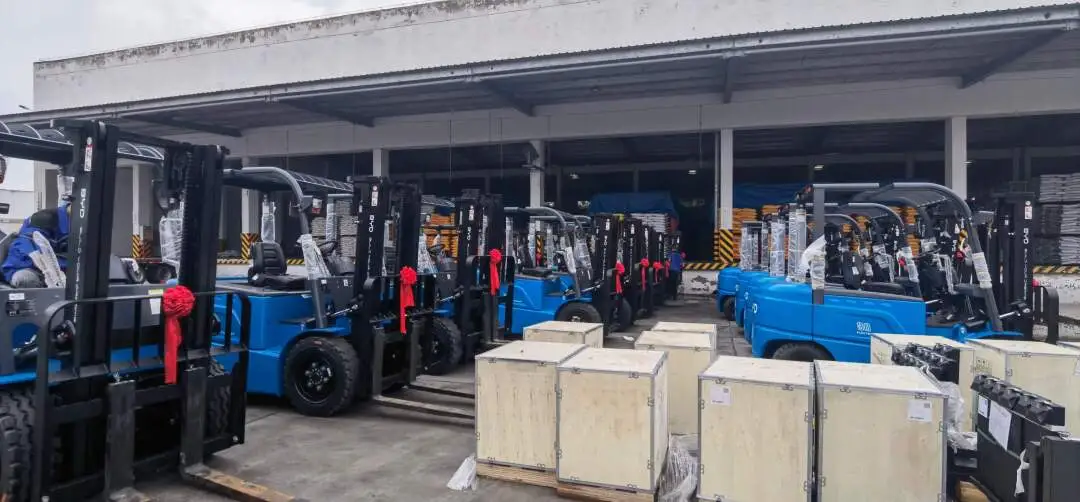
Täglicher Umschlag von grenzüberschreitenden Zolllagern, praktischer Betrieb von kleinen dreirädrigen Elektrostaplern(Figur1)

Als zentraler Knotenpunkt für den Transit von Import- und Exportgütern hat das grenzüberschreitende Zolllager eine hohe Frequenz des täglichen Frachtumschlags und starke Platzbeschränkungen, was strenge Anforderungen an die Flexibilität und Effizienz der Umschlaggeräte stellt. Kleine dreirädrige Elektrostapler sind aufgrund ihrer kompakten Größe und flexiblen Lenkleistung zur Hauptausrüstung für den Kurzstreckentransport und den Schmalkanalbetrieb in Zolllagern geworden. Heute kombinieren wir die reale Szene, um den täglichen praktischen Betriebsprozess im Detail zu erläutern.

Der Inspektionsprozess vor dem eigentlichen Betrieb ist die Grundlage für einen sicheren Betrieb. In der realen Aufnahme ist zu sehen, dass der Bediener zunächst eine Inspektion des Aussehens des Gabelstaplers durchführt: Vergewissern Sie sich, dass die Gabel keine Verformungsrisse aufweist und der Reifendruck normal ist, und starten Sie dann den Gabelstapler, um die Leistungsanzeige, die Empfindlichkeit des Bremssystems und die Leichtgängigkeit des Lenkmechanismus zu überprüfen. Obwohl diese Details einfach sind, können sie versteckte Gefahren im Betrieb effektiv vermeiden.

Beim Betreten des Be- und Entladevorgangs nähert sich der Bediener in der realen Szene langsam der zu transportierenden standardisierten Palette, passt den Gabelabstand an das Loch der Palettengabel an und hebt die Gabel dann sanft an, bis der Boden der Palette vollständig vom Boden abgehoben ist (ca. 10-15 cm), um Kratzer auf dem Boden oder Verformungen des Tabletts zu vermeiden. Halten Sie während der Fahrt eine konstante Geschwindigkeit ein und schlagen Sie beim Passieren des Regalbereichs und der Fußgängerpassage im Zolllager im Voraus Alarm, um die Sicherheit des umliegenden Personals zu gewährleisten.

Das Fahren in der engen Rinne des Zolllagers ist eine häufige Szene, und die Vorteile kleiner dreirädriger Elektrostapler werden hier hervorgehoben. In der realen Aufnahme ist zu erkennen, dass der Bediener seinen kleinen Wenderadius nutzt, um in der Rinne, die nur Einzelradverkehr zulässt, präzise zu lenken und die Gabeln während des gesamten Prozesses stabil zu halten, ohne die Ware zu erschüttern. Es ist zu beachten, dass beim Fahren in der Rinne ein Sicherheitsabstand von mindestens 30 cm zu den Regalen auf beiden Seiten eingehalten werden sollte, um ein Verkratzen der Regale oder Waren zu vermeiden.

Der Stapelvorgang ist eines der zentralen Glieder des Zolllagerumschlags. Die reale Aufnahme zeigt, dass der Bediener den Gabelstapler zunächst auf den Boden des Zielladeraums fährt, die Karosserie auf den Laderaum ausrichtet, die Gabel langsam auf die angegebene Höhe anhebt, sie auf den Regalbalken ausrichtet und die Waren sanft einlegt, dann die Gabel langsam absenkt und sich zurückzieht. Der gesamte Prozess ist kohärent, und es gibt keinen plötzlichen Heben und Fallen, was die Sicherheit der Waren und Regale wirksam gewährleistet.

Darüber hinaus wurde der Endbearbeitungsprozess nach dem Vorgang auch in der realen Aufnahme aufgezeichnet: Der Bediener legte den Gabelstapler in der vorgesehenen Ladefläche an, ließ die Gabel auf den Boden ab, schaltete die Stromversorgung ab und reinigte Staub und Schmutz auf der Oberfläche des Gabelstaplers, um sicherzustellen, dass sich das Gerät in einem guten Standby-Zustand befand und für den nächsten Vorgang bereit war.

Der praktische Betrieb von kleinen dreirädrigen Elektrostaplern in grenzüberschreitenden Zolllagern konzentriert sich nicht nur auf die Verbesserung der Effizienz, sondern legt auch Wert auf Sicherheitsnormen. Durch standardisierte Betriebsverfahren und sorgfältige tägliche Wartung kann es die Umsatznachfrage von Zolllagern wirksam unterstützen und das Verlustrisiko bei der Handhabung verringern.

Telefon

WeChat

Whatsapp

E-Mail Adresse

We use cookie to improve your online experience. By continuing to browse this website, you agree to our use of cookie.

Cookies

Please read our Terms and Conditions and this Policy before accessing or using our Services. If you cannot agree with this Policy or the Terms and Conditions, please do not access or use our Services. If you are located in a jurisdiction outside the European Economic Area, by using our Services, you accept the Terms and Conditions and accept our privacy practices described in this Policy.
We may modify this Policy at any time, without prior notice, and changes may apply to any Personal Information we already hold about you, as well as any new Personal Information collected after the Policy is modified. If we make changes, we will notify you by revising the date at the top of this Policy. We will provide you with advanced notice if we make any material changes to how we collect, use or disclose your Personal Information that impact your rights under this Policy. If you are located in a jurisdiction other than the European Economic Area, the United Kingdom or Switzerland (collectively “European Countries”), your continued access or use of our Services after receiving the notice of changes, constitutes your acknowledgement that you accept the updated Policy. In addition, we may provide you with real time disclosures or additional information about the Personal Information handling practices of specific parts of our Services. Such notices may supplement this Policy or provide you with additional choices about how we process your Personal Information.


Cookies

Cookies are small text files stored on your device when you access most Websites on the internet or open certain emails. Among other things, Cookies allow a Website to recognize your device and remember if you've been to the Website before. Examples of information collected by Cookies include your browser type and the address of the Website from which you arrived at our Website as well as IP address and clickstream behavior (that is the pages you view and the links you click).We use the term cookie to refer to Cookies and technologies that perform a similar function to Cookies (e.g., tags, pixels, web beacons, etc.). Cookies can be read by the originating Website on each subsequent visit and by any other Website that recognizes the cookie. The Website uses Cookies in order to make the Website easier to use, to support a better user experience, including the provision of information and functionality to you, as well as to provide us with information about how the Website is used so that we can make sure it is as up to date, relevant, and error free as we can. Cookies on the Website We use Cookies to personalize your experience when you visit the Site, uniquely identify your computer for security purposes, and enable us and our third-party service providers to serve ads on our behalf across the internet.

We classify Cookies in the following categories:
 ●  Strictly Necessary Cookies
 ●  Performance Cookies
 ●  Functional Cookies
 ●  Targeting Cookies


Cookie List
A cookie is a small piece of data (text file) that a website – when visited by a user – asks your browser to store on your device in order to remember information about you, such as your language preference or login information. Those cookies are set by us and called first-party cookies. We also use third-party cookies – which are cookies from a domain different than the domain of the website you are visiting – for our advertising and marketing efforts. More specifically, we use cookies and other tracking technologies for the following purposes:

Strictly Necessary Cookies
These cookies are necessary for the website to function and cannot be switched off in our systems. They are usually only set in response to actions made by you which amount to a request for services, such as setting your privacy preferences, logging in or filling in forms. You can set your browser to block or alert you about these cookies, but some parts of the site will not then work. These cookies do not store any personally identifiable information.

Functional Cookies
These cookies enable the website to provide enhanced functionality and personalisation. They may be set by us or by third party providers whose services we have added to our pages. If you do not allow these cookies then some or all of these services may not function properly.

Performance Cookies
These cookies allow us to count visits and traffic sources so we can measure and improve the performance of our site. They help us to know which pages are the most and least popular and see how visitors move around the site. All information these cookies collect is aggregated and therefore anonymous. If you do not allow these cookies we will not know when you have visited our site, and will not be able to monitor its performance.

Targeting Cookies
These cookies may be set through our site by our advertising partners. They may be used by those companies to build a profile of your interests and show you relevant adverts on other sites. They do not store directly personal information, but are based on uniquely identifying your browser and internet device. If you do not allow these cookies, you will experience less targeted advertising.

How To Turn Off Cookies
You can choose to restrict or block Cookies through your browser settings at any time. Please note that certain Cookies may be set as soon as you visit the Website, but you can remove them using your browser settings. However, please be aware that restricting or blocking Cookies set on the Website may impact the functionality or performance of the Website or prevent you from using certain services provided through the Website. It will also affect our ability to update the Website to cater for user preferences and improve performance. Cookies within Mobile Applications

We only use Strictly Necessary Cookies on our mobile applications. These Cookies are critical to the functionality of our applications, so if you block or delete these Cookies you may not be able to use the application. These Cookies are not shared with any other application on your mobile device. We never use the Cookies from the mobile application to store personal information about you.

If you have questions or concerns regarding any information in this Privacy Policy, please contact us by email at . You can also contact us via our customer service at our Site.