2026-07-08

Notfallbehandlung von Türrahmenkettenbrüchen, Vorschlag für BYD-Gabelstapler-Stützzubehör für die Bevorratung

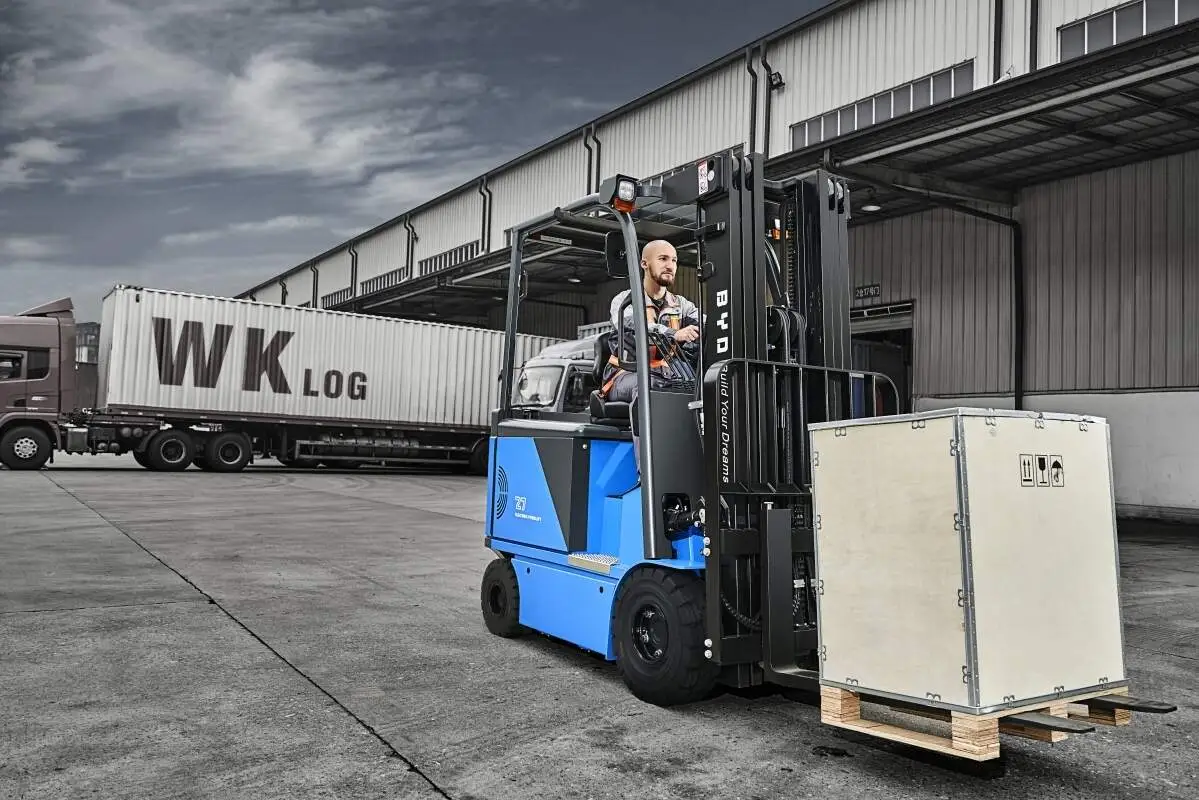
Notfallbehandlung von Türrahmenkettenbrüchen, Vorschlag für BYD-Gabelstapler-Stützzubehör für die Bevorratung(Figur1)

Elektrische Gabelstapler sind die wichtigsten Betriebsmittel in Lager- und Logistikszenarien. Die Portalkette spielt eine Schlüsselrolle beim Heben von Gabeln und beim Transport von Gütern. Einmal gebrochen, unterbricht sie nicht nur den Betriebsfortschritt, sondern kann auch Sicherheitsrisiken wie herabfallende Güter und Geräteschäden verursachen. Die Beherrschung der richtigen Notfallbehandlungsmethoden und die Bevorratung von unterstützendem Zubehör sind wichtige Maßnahmen, um den sicheren und stabilen Betrieb von Gabelstaplern zu gewährleisten.

Zunächst die Notfallbehandlungsschritte für die gebrochene Türrahmenkette

1. Stoppen Sie sofort den Betrieb und evakuieren Sie das Personal: Nachdem festgestellt wurde, dass die Kette gebrochen ist, drücken Sie so schnell wie möglich den Not-Aus-Knopf des Gabelstaplers, um die Stromquelle zu unterbrechen, und leiten Sie die umliegenden Arbeiter an, sich in einen sicheren Bereich zu begeben, um Sekundärverletzungen durch Schütteln von Teilen oder herabfallende Güter zu vermeiden.

2. Sicherheitsuntersuchung vor Ort: Unter der Prämisse, die eigene Sicherheit zu gewährleisten, überprüfen Sie zunächst die Lage und den Bruchgrad der gebrochenen Kette sowie, ob der Türrahmen, die Gabel und andere zugehörige Komponenten verformt oder beschädigt sind. Es ist strengstens untersagt, den Gabelstapler gewaltsam zu betätigen, um die Teile zu bewegen oder anzuheben, um eine Ausdehnung des Fehlers zu verhindern.

3. Vorübergehender Schutz und Isolierung: Verwenden Sie Warnschilder, um den defekten Gabelstapler einzuschließen und irrelevantes Personal daran zu erinnern, sich fernzuhalten. Wenn die Bruchkette abzufallen droht, kann ein spezieller Umreifungsgurt zur vorübergehenden Befestigung verwendet werden, um Unfälle durch herunterfallende Teile zu vermeiden.

4. Wenden Sie sich an professionelles Wartungspersonal: Benachrichtigen Sie rechtzeitig qualifiziertes Gabelstapler-Wartungspersonal, das am Einsatzort eintrifft, und informieren Sie es ausführlich über den Ausfall, damit das Wartungspersonal geeignete Werkzeuge und Zubehör zum Einsatzort bringen und die Wartezeit für die Wartung verkürzen kann.

2. Vorschläge für die Bevorratung von Zubehör

1. Angemessene Bevorratung von Kernzubehör: Je nach Nutzungshäufigkeit, Betriebslast und Wartungszyklus des Gabelstaplers wird empfohlen, 1-2 Mastketten des geeigneten Modells aufzubewahren, um sicherzustellen, dass sie im Falle eines Ausfalls schnell ausgetauscht werden können. Gleichzeitig kann er mit verschleißfesten Kleinteilen wie Strumpfkettenstiften und Spannvorrichtungen ausgestattet werden, um Wartungsverzögerungen aufgrund fehlender Kleinteile zu vermeiden.

2. Standardisieren Sie die Lagerung von Zubehör: Das Zubehör muss in einer trockenen, belüfteten und nicht korrosiven Umgebung gelagert werden, um zu vermeiden, dass die Kette feucht, verrostet oder mit Öl verunreinigt wird, was die Lebensdauer beeinträchtigt. Machen Sie klare Zeichen bei der Lagerung, markieren Sie das Modell des Zubehörs und den Typ des geeigneten Gabelstaplers, was für eine schnelle Suche im Notfall praktisch ist.

3. Regelmäßige Überprüfung des Lagerbestands: Einrichtung eines Ersatzteilbestandskontos, regelmäßige Überprüfung der Anzahl der Ersatzteile und des Status der Ersatzteile, rechtzeitige Nachfüllung unzureichender Ersatzteile, um eine ausreichende Notversorgung sicherzustellen. Gleichzeitig wird in Verbindung mit den täglichen Wartungsaufzeichnungen der Verlust von Ersatzteilen vorhergesehen und der Lagerplan dynamisch angepasst.

Im täglichen Betrieb ist es außerdem notwendig, die Türrahmenkette regelmäßig zu überprüfen und zu warten, einschließlich Kettenspannung, Verschleißgrad, Schmierzustand usw., um versteckte Gefahren rechtzeitig zu erkennen und zu beseitigen, um das Risiko eines Kettenbruchs an der Quelle zu verringern. Eine standardisierte Notfallbehandlung und eine angemessene Lagerung von Ersatzteilen können die Sicherheit und Kontinuität des Gabelstaplerbetriebs wirksam verbessern und die Effizienz des Logistikbetriebs unterstützen.
Telefon

WeChat

Whatsapp

E-Mail Adresse

We use cookie to improve your online experience. By continuing to browse this website, you agree to our use of cookie.

Cookies

Please read our Terms and Conditions and this Policy before accessing or using our Services. If you cannot agree with this Policy or the Terms and Conditions, please do not access or use our Services. If you are located in a jurisdiction outside the European Economic Area, by using our Services, you accept the Terms and Conditions and accept our privacy practices described in this Policy.
We may modify this Policy at any time, without prior notice, and changes may apply to any Personal Information we already hold about you, as well as any new Personal Information collected after the Policy is modified. If we make changes, we will notify you by revising the date at the top of this Policy. We will provide you with advanced notice if we make any material changes to how we collect, use or disclose your Personal Information that impact your rights under this Policy. If you are located in a jurisdiction other than the European Economic Area, the United Kingdom or Switzerland (collectively “European Countries”), your continued access or use of our Services after receiving the notice of changes, constitutes your acknowledgement that you accept the updated Policy. In addition, we may provide you with real time disclosures or additional information about the Personal Information handling practices of specific parts of our Services. Such notices may supplement this Policy or provide you with additional choices about how we process your Personal Information.


Cookies

Cookies are small text files stored on your device when you access most Websites on the internet or open certain emails. Among other things, Cookies allow a Website to recognize your device and remember if you've been to the Website before. Examples of information collected by Cookies include your browser type and the address of the Website from which you arrived at our Website as well as IP address and clickstream behavior (that is the pages you view and the links you click).We use the term cookie to refer to Cookies and technologies that perform a similar function to Cookies (e.g., tags, pixels, web beacons, etc.). Cookies can be read by the originating Website on each subsequent visit and by any other Website that recognizes the cookie. The Website uses Cookies in order to make the Website easier to use, to support a better user experience, including the provision of information and functionality to you, as well as to provide us with information about how the Website is used so that we can make sure it is as up to date, relevant, and error free as we can. Cookies on the Website We use Cookies to personalize your experience when you visit the Site, uniquely identify your computer for security purposes, and enable us and our third-party service providers to serve ads on our behalf across the internet.

We classify Cookies in the following categories:
 ●  Strictly Necessary Cookies
 ●  Performance Cookies
 ●  Functional Cookies
 ●  Targeting Cookies


Cookie List
A cookie is a small piece of data (text file) that a website – when visited by a user – asks your browser to store on your device in order to remember information about you, such as your language preference or login information. Those cookies are set by us and called first-party cookies. We also use third-party cookies – which are cookies from a domain different than the domain of the website you are visiting – for our advertising and marketing efforts. More specifically, we use cookies and other tracking technologies for the following purposes:

Strictly Necessary Cookies
These cookies are necessary for the website to function and cannot be switched off in our systems. They are usually only set in response to actions made by you which amount to a request for services, such as setting your privacy preferences, logging in or filling in forms. You can set your browser to block or alert you about these cookies, but some parts of the site will not then work. These cookies do not store any personally identifiable information.

Functional Cookies
These cookies enable the website to provide enhanced functionality and personalisation. They may be set by us or by third party providers whose services we have added to our pages. If you do not allow these cookies then some or all of these services may not function properly.

Performance Cookies
These cookies allow us to count visits and traffic sources so we can measure and improve the performance of our site. They help us to know which pages are the most and least popular and see how visitors move around the site. All information these cookies collect is aggregated and therefore anonymous. If you do not allow these cookies we will not know when you have visited our site, and will not be able to monitor its performance.

Targeting Cookies
These cookies may be set through our site by our advertising partners. They may be used by those companies to build a profile of your interests and show you relevant adverts on other sites. They do not store directly personal information, but are based on uniquely identifying your browser and internet device. If you do not allow these cookies, you will experience less targeted advertising.

How To Turn Off Cookies
You can choose to restrict or block Cookies through your browser settings at any time. Please note that certain Cookies may be set as soon as you visit the Website, but you can remove them using your browser settings. However, please be aware that restricting or blocking Cookies set on the Website may impact the functionality or performance of the Website or prevent you from using certain services provided through the Website. It will also affect our ability to update the Website to cater for user preferences and improve performance. Cookies within Mobile Applications

We only use Strictly Necessary Cookies on our mobile applications. These Cookies are critical to the functionality of our applications, so if you block or delete these Cookies you may not be able to use the application. These Cookies are not shared with any other application on your mobile device. We never use the Cookies from the mobile application to store personal information about you.

If you have questions or concerns regarding any information in this Privacy Policy, please contact us by email at . You can also contact us via our customer service at our Site.